Sovereign Strength
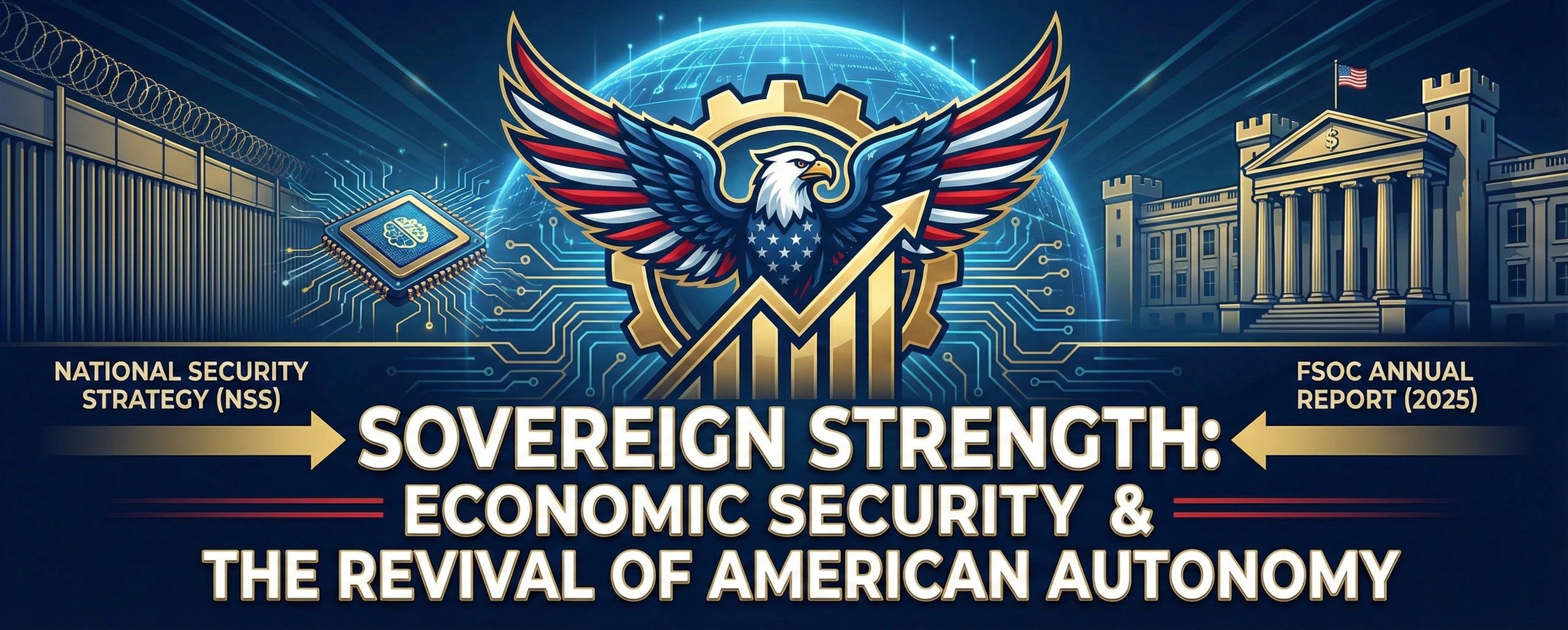
In the waning days of 2025, two pivotal documents from the U.S. government – the National Security Strategy (NSS) released by the White House in November and the Financial Stability Oversight Council’s (FSOC) Annual Report approved in December – signal a profound shift in American strategic thinking. Both articulate a vision of U.S. sovereignty that prioritizes economic resilience, technological dominance, and defenses against external threats, marking a departure from the globalist paradigms of the post-Cold War era. This convergence is not coincidental; it reflects a deliberate effort to harmonize foreign policy with financial oversight, ensuring that America’s power is rooted in self-sufficiency rather than entangling alliances or unchecked international dependencies (White House, 2025; FSOC, 2025). It is an America First agenda focused on U.S. sovereignty.
At the heart of this framework is the concept of economic security, elevated as a cornerstone of national sovereignty. The NSS explicitly links economic vitality to deterrence, asserting that “cultivating American industrial strength must become the highest priority of national economic policy” to achieve energy dominance, balanced trade, and secure supply chains. Echoing this, the FSOC report redefines financial stability to encompass “secure and resilient domestic production capacity,” emphasizing how sustainable growth reduces debt burdens and bolsters fiscal positions against external shocks. Analysts have noted this synergy as a pragmatic response to geopolitical uncertainties, with economic nationalism serving as a bulwark against vulnerabilities in global markets (Brookings Institution, 2025; Council on Foreign Relations, 2025).
This emphasis on sovereignty manifests in a shared rejection of transnational dependencies that erode U.S. autonomy. The NSS critiques past elites for binding American policy to international institutions that “explicitly seek to dissolve individual state sovereignty,” advocating instead for reciprocal trade deals and burden-sharing in alliances, such as NATO’s elevated defense spending commitments. Similarly, the FSOC highlights the need to monitor offshore financial flows, like reinsurance markets, and supports innovations such as U.S. dollar-denominated stablecoins to maintain the dollar’s global primacy without ceding control. Such measures, as observed in policy reviews, aim to insulate the U.S. from foreign economic coercion while fostering domestic competitiveness (Foreign Policy Research Institute, 2025; American Action Forum, 2025).
Geopolitical and cyber threats form another critical nexus, where both documents advocate proactive defenses to safeguard sovereignty. The NSS outlines strategies to counter “hostile influence” through border security, quantum technology investments, and regional doctrines like the Trump Corollary to the Monroe Doctrine, which denies non-hemispheric powers strategic footholds in the Americas. The FSOC complements this by establishing working groups focused on cyberattacks and disruptions from “threat actors,” including nation-states, underscoring the interdependence of financial systems and national defense. This integrated approach has been praised for its realism, recognizing that economic security is inseparable from military posture in an era of hybrid threats (Center for Strategic and International Studies, 2025; Stimson Center, 2025).
Technological leadership emerges as a key enabler of this sovereign vision, with AI and digital assets positioned as tools for autonomy. The NSS calls for U.S. dominance in AI, biotech, and quantum computing to prevent adversarial advantages, while promoting flexible alliances like the Quad. The FSOC’s new AI working group seeks to streamline regulatory adoption and identify high-value use cases, reflecting a shift toward innovation-driven resilience. As policy experts argue, this focus mitigates risks from technological dependencies abroad, ensuring America’s edge in a multipolar world (University of California Berkeley, 2025; Office of Financial Research, 2025).
Resilience at the household and national levels further underpins this strategy, fostering long-term stability. The NSS stresses restoring “spiritual and cultural health” alongside economic dynamism to withstand societal shocks. In parallel, the FSOC’s household resilience group monitors balance sheets and credit access, arguing that strong domestic finances enable entrepreneurial mobility and buffer against downturns. This holistic view aligns with broader analyses that view sovereignty as encompassing both macro and micro-level fortifications (Board of Governors of the Federal Reserve System, 2025).
Critics, such as Senator Elizabeth Warren, have decried these policies as a reckless embrace of deregulation and isolationism, potentially exacerbating financial instability and alienating allies (Warren, 2025a; Warren, 2025b). Yet such concerns overlook the strategic intent: far from retreating, this framework enhances U.S. leverage by prioritizing sustainable growth over burdensome global commitments, as evidenced by the NSS’s emphasis on “peace through strength” and the FSOC’s balanced monitoring of risks (Center for Strategic and International Studies, 2025). Historical precedents, like the post-2008 reforms, demonstrate that targeted deregulation can spur innovation without systemic peril, countering fears of unchecked capitalism with evidence-based prudence (Council on Foreign Relations, 2025).
Ultimately, the 2025 NSS and FSOC report herald a recalibrated American grand strategy, where sovereignty is maximized through the fusion of security and finance. By addressing vulnerabilities at their economic roots, the U.S. positions itself not as a global hegemon but as a resilient power capable of navigating an uncertain world. This evolution, while contentious, may prove essential for sustaining American primacy in the decades ahead (European Parliament, 2025; OSW Centre for Eastern Studies, 2025). America should once again serve as a shining example – a “city upon a hill” – that inspires the world.
JAS