The First State’s Last Chance
Why Delaware Must Pivot from Corporate Law to Energy Sovereignty
Geography is destiny, but policy is choice. For more than a century, Delaware has punched above its weight by making a specific set of strategic choices. By crafting the world’s most sophisticated corporate legal framework, it positioned itself as the “Corporate Capital” – a neutral, predictable sanctuary where the world’s businesses exist on paper.
But as 2025 draws to a close, the era of “paper sovereignty” is ending. The geopolitical currency of the twenty-first century is no longer incorporation fees or legal predictability alone – it is physical energy and computational power. On this new front, Delaware is not leading, it is dying.
The sharp electricity price spikes of late 2025 are not merely a market fluctuation, they are the death rattle of a failed strategy. For two decades, under the inertia of uncontested single-party rule, Dover has pursued a policy of managed decline. The state has shuttered its domestic generation, outsourced its energy security to the volatile PJM regional market, and prioritized ideological mandates over the hard physics of grid reliability. The result is a state that imports nearly all its power, exports its wealth to generators in Pennsylvania, and watches helplessly as its industrial base erodes.
Delaware now faces a stark choice: continue to drift sideways into irrelevance as a vassal of the regional grid, or execute a radical transformation. It is time to replace the “Delaware Way” of consensus management with a doctrine of energy realism. The state must decouple from the failing PJM market, re-industrialize through nuclear capability, and leverage its judicial hegemony to become the Switzerland of AI – a fortress of abundant power and sovereign data.
The Consensus Trap
The crisis of 2025 was entirely predictable. For twenty years, Delaware’s leadership has viewed energy policy as a subset of environmental advocacy rather than national security. By creating a hostile regulatory environment for thermal generation, the state forced the retirement of dispatchable assets, believing it could rely on neighbors to keep the lights on.
This was a strategic miscalculation. As the PJM Interconnection buckles under the combined weight of retiring coal plants and the insatiable demand of data centers, the import-only strategy has left Delaware exposed. We are paying a premium for scarcity.
More damning is the economic cost. While other states aggressively court the Artificial Intelligence revolution, Delaware has nothing to offer but high rates and grid congestion. We have become a flyover state for critical infrastructure. The current political monopoly in Dover has produced a comfortable stagnation, managing a slow decline rather than engineering a leap forward. To reverse this, we must abandon the illusion that we can legislate prosperity without building the physical infrastructure to support it.
The Chancery Shield: The Switzerland of AI

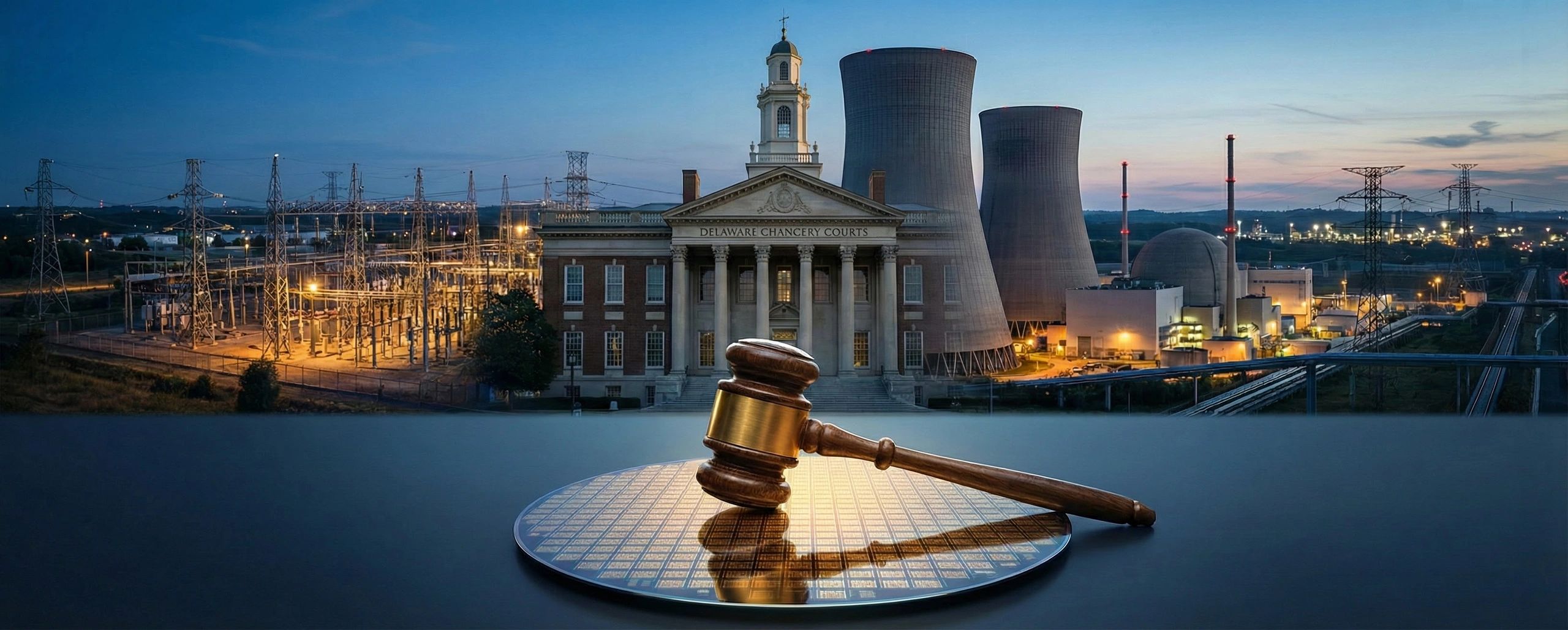
To reverse this decline, Delaware must do what it has always done best: leverage the law. But this time, we must tether our legal supremacy to our physical soil. The centerpiece of this new industrial strategy is the Chancery Shield.
The General Assembly should establish a specialized “Data Sanctum” docket within the Court of Chancery, building on its existing jurisdiction over technology disputes under 10 Del. C. § 346. This framework would offer enhanced protections and procedural advantages, available to AI and technology firms that commit to meaningful physical presence in Delaware:
Expedited Resolution of Key Disputes: In the fast-moving world of Large Language Models (LLMs) and algorithmic innovation, delays in litigation can erode competitive edges. The Data Sanctum docket would prioritize eligible cases – where parties consent to Chancery jurisdiction – for expedited proceedings, leveraging the court’s proven expertise in granting motions to expedite for colorable claims involving irreparable harm. Adjudicated by the nation’s most sophisticated business judges, these matters could advance to resolution on abbreviated schedules, often in weeks or months, providing the certainty and speed that AI innovators demand.
Enhanced Procedural Predictability and Expertise: Drawing on the Chancery’s equitable powers, the docket would emphasize robust protections for trade secrets, contractual rights, and proprietary algorithms in commercial disputes. Parties qualifying through physical investment would benefit from presumptive expedition, dedicated case management, and the court’s deep bench of precedent in complex technology and corporate matters – fostering a reliable forum that minimizes uncertainty in high-stakes IP, licensing, and partnership conflicts.
However, there is a nexus requirement: Access to the full advantages of the Chancery Shield would be conditioned on physical investment in Delaware, such as locating servers, data centers, or significant operations within the state and integrating with its emerging sovereign energy grid. This creates a powerful feedback loop. We trade unparalleled legal predictability and expertise for tangible economic commitment, driving job creation, infrastructure development, and the establishment of Delaware as the premier U.S. hub for AI innovation – the trusted forum where global leaders site their critical compute.
The Sovereignty Doctrine
You cannot invite the world’s most power-hungry companies to Delaware if you cannot keep the lights on. Therefore, the Chancery Shield must be backed by Energy Sovereignty.
Delaware must transition from a passive market participant to an independent energy operator. This requires a legal and structural secession from the PJM capacity market through the election of the Fixed Resource Requirement (FRR) status.
Under an FRR regime, Delaware would no longer be subject to the whims of a thirteen-state auction. Instead, we would legally opt out, creating an “energy island” where we are responsible for our own reliability. To execute this, the General Assembly must charter a Delaware Energy & Data Authority (DEDA). Unlike the toothless bureaucracies of the past, DEDA must be a sovereign entity with the power of eminent domain and the authority to issue revenue bonds. Its mandate is singular: to secure affordable, firm power for the state’s residential base and industrial expansion, free from the constraints of regional politics.
The Realist Bridge: Coal and Nuclear
.jpg/:/rs=w:1280)
A serious nation – or a serious state – does not discard its shield before it has forged a new one. The rapid dismissal of coal generation at Indian River, driven by Renewable Portfolio Standards (RPS) rather than engineering reality, was a mistake.
To secure the bridge to the future, Delaware must utilize the Federal Power Act’s Section 202(c) to declare the Indian River power station a critical national security asset. By securing a federal emergency order to keep the plant online, Delaware secures 400 megawatts of immediate, dispatchable baseload. This is not about nostalgia for fossil fuels; it is about the cold logic of reliability. This “Coal Bridge” provides the immediate stability required to attract hyperscale data centers today, not ten years from now.
But coal is merely the bridge. The destination is the atom.
Delaware’s geography and industrial legacy make it the ideal candidate for a Small Modular Reactor (SMR) fleet. The Indian River and Edgemoor sites possess the “holy trinity” of grid infrastructure: cooling water, high-voltage transmission, and industrial zoning. DEDA must immediately launch a procurement program to site 1.2 gigawatts of nuclear capacity. Nuclear power is the only technology that offers the density and reliability required to power the AI economy while ultimately decarbonizing the grid.
The Innovation Dividend
.jpg/:/cr=t:0%25,l:0%25,w:100%25,h:100%25/rs=w:1280)
Why take this path? Because the “Cloud” is not ethereal – it is made of steel, silicon, and electricity. By offering sovereign power and legal protection, Delaware can extract an Innovation Dividend.
New mandates should require AI tenants utilizing the Chancery Shield to allocate a percentage of their compute capacity to a Delaware National Laboratory, a new consortium of the University of Delaware and Delaware State University. This democratizes supercomputing access for our researchers, turning Newark and Dover into global hubs for protein folding, fusion simulation, and materials science. We would transform our workforce from retail and logistics to nuclear operation and frontier research.
The Choice
For twenty years, Delaware has drifted, content to be a suburban bedroom community for Philadelphia and a mailbox for the Fortune 500. That era is over. The future belongs to those who can generate their own power, protect their own data, and adjudicate their own future.
The plan outlined here – regulatory repeal, the Chancery Shield, and a nuclear industrial renaissance – is not without risk. It requires confronting the comfortable consensus of the last two decades. It requires admitting that the previous path was a failure.
But the alternative is a slow slide into obscurity, burdened by crushing utility bills and bypassed by the greatest industrial transformation of our time. Delaware was the First State to ratify the Constitution. It is time to be the First State to ratify a declaration of energy and digital independence. We must stop managing our decline and start building our power.
JAS