
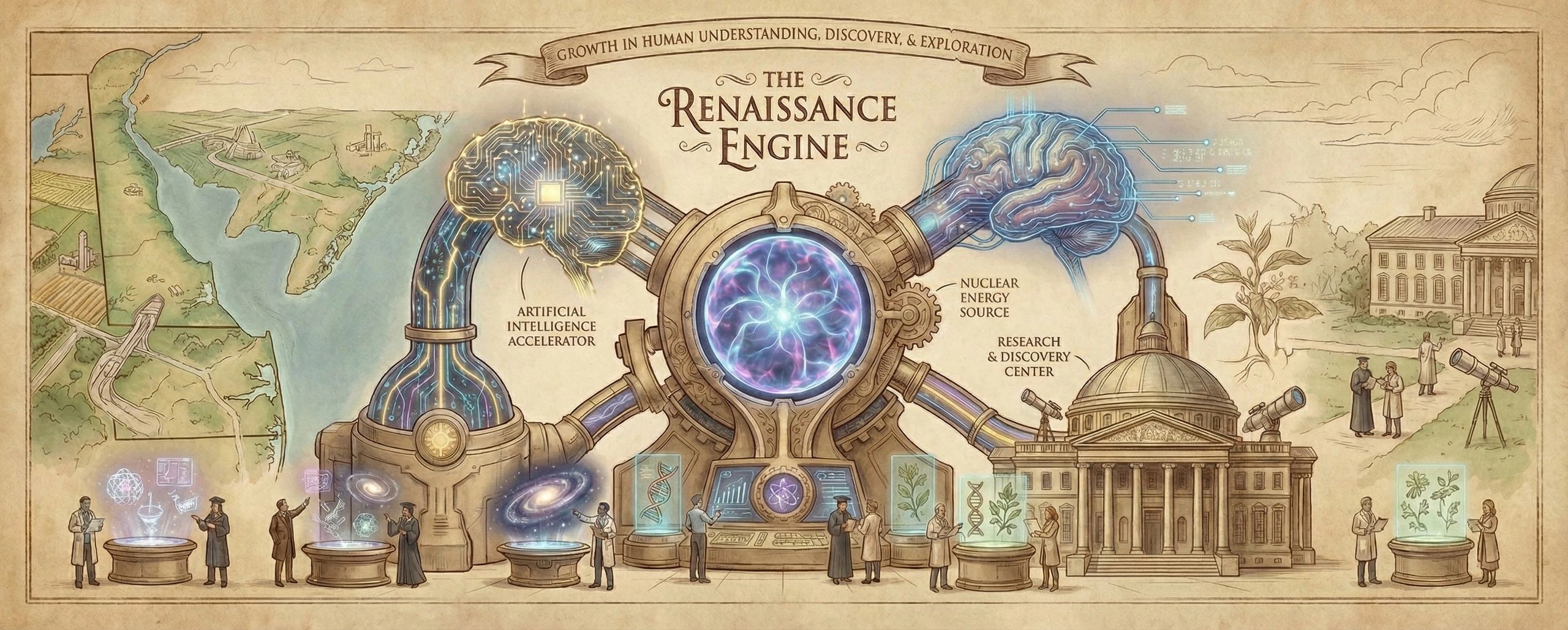
The Renaissance Engine
Powering the Next Era of Human Progress
In an age of accelerating technological change, the convergence of energy abundance and computational power is reshaping the frontiers of human endeavor. The rapid advancement of artificial intelligence (AI), coupled with the unrelenting growth of data-intensive industries, has exposed a fundamental constraint: energy. Data centers, the backbone of the digital economy, consume vast amounts of electricity with no end in sight. Yet this challenge presents an opportunity – a pathway to a new model of industrial and scientific renaissance.
The “Renaissance Engine” offers a replicable framework for states and nations to harness this moment. It integrates advanced nuclear power plants, colocated data centers (augmented by Bitcoin mining for flexibility and revenue), university-linked research hubs, and tailored legal incentives. This symbiotic system not only addresses immediate energy demands but positions adopters as leaders in the AI-driven economy, fostering innovation akin to the great leaps of the space race or the industrial revolution. As with historical pivots toward new energy paradigms – from coal to oil, or fission to fusion – the Renaissance Engine represents the next step in humanity’s quest for mastery over nature and physics.
The Imperative of Abundance
Geography and resources have long dictated national fortunes, but policy choices determine who thrives in eras of transformation. Today, the currency of power is no longer merely territory or capital. It is reliable, low-carbon energy paired with computational capacity. AI training and inference require uninterrupted baseload power, far beyond what intermittent renewables alone can provide. Projections indicate that global data center electricity demand could double or triple to around 945 terawatt-hours (TWh) by 2030, driven by large language models and hyperscale computing (International Energy Agency, 2025).
States reliant on imported energy or volatile regional markets risk irrelevance. Conversely, those achieving energy sovereignty – control over firm, dispatchable power – can attract the world’s most capital-intensive industries: AI firms, biotechnology, and advanced manufacturing. The Renaissance Engine provides a blueprint for this sovereignty, drawing on proven technologies while creating virtuous cycles of investment and discovery.
The Core Components

At its heart, the Engine revolves around Small Modular Reactors (SMRs) or other advanced nuclear facilities. These compact, factory-built reactors offer scalability, enhanced safety through passive cooling, and rapid deployment compared to traditional gigawatt-scale plants. Co-located directly with load centers, they eliminate transmission losses and provide carbon-free baseload power.
Integrated data centers form the second pillar. Hyperscalers and AI developers demand proximity to abundant electricity which co-location ensures. To enhance grid flexibility and generate revenue, Bitcoin mining serves as an optional but powerful feature. Mining operations are highly flexible. They can ramp down in seconds during peak demand or excess periods, stabilizing the grid while monetizing surplus energy. Real-world examples abound: Nautilus Cryptomine at Susquehanna Nuclear Power Plant, Core Scientific, Hut 8, Iris Energy, and others. Facilities adjacent to power sources have paired mining with AI workloads, using high percentages of zero-carbon power and providing demand response services.
The third element is research centers with direct university linkages. A portion of compute capacity allocated through mandates or incentives supports public-private consortia. Universities gain access to supercomputing for fields like materials science, drug discovery, and physics, democratizing frontier tools. This echoes historical models, such as the Manhattan Project or Apollo program, where national investments yielded spillover innovations.
Finally, novel legal frameworks bind the system. Specialized regulatory zones or incentives – expedited permitting, tax credits conditioned on local investment, or dedicated judicial dockets for technology disputes – attract private capital. These create feedback loops: firms commit to physical presence in exchange for predictability and power security.
A Model for Sovereignty
This Engine is inherently reusable. For a mid-sized U.S. state facing grid constraints, chartering an energy authority to procure SMRs and opt into independent reliability standards mirrors successful nuclear revivals. Nations like those in Southeast Asia or the Middle East, building data hubs amid energy transitions, can adapt it by prioritizing export-oriented compute.
Early adopters are emerging. Tech giants have committed billions to SMR development for data centers, while countries from China to the United Arab Emirates integrate nuclear with AI strategies. Bitcoin mining’s role in grid balancing – absorbing surplus from baseload nuclear – has proven economically viable, improving plant utilization and decarbonizing operations.
The Horizon of Exploration
The Renaissance Engine is more than infrastructure, it is a doctrine for progress. Humanity’s greatest achievements – voyages of discovery, scientific revolutions, space exploration – required energy mastery. Today, AI promises breakthroughs in fusion energy, personalized medicine, and sustainable systems, but only if powered reliably.
By deploying this Engine, states and nations can escape energy vassalage, cultivate intellectual capital, and lead the next wave of endeavor. The alternative is stagnation, bypassed by competitors who control the atom and the algorithm. In this century, as in past ones, those who build abundance will define the future. The choice is clear – ignite the Engine, or fade into dependence.
Reference.
International Energy Agency. (2025). Energy and AI. https://www.iea.org/reports/energy-and-ai
JAS