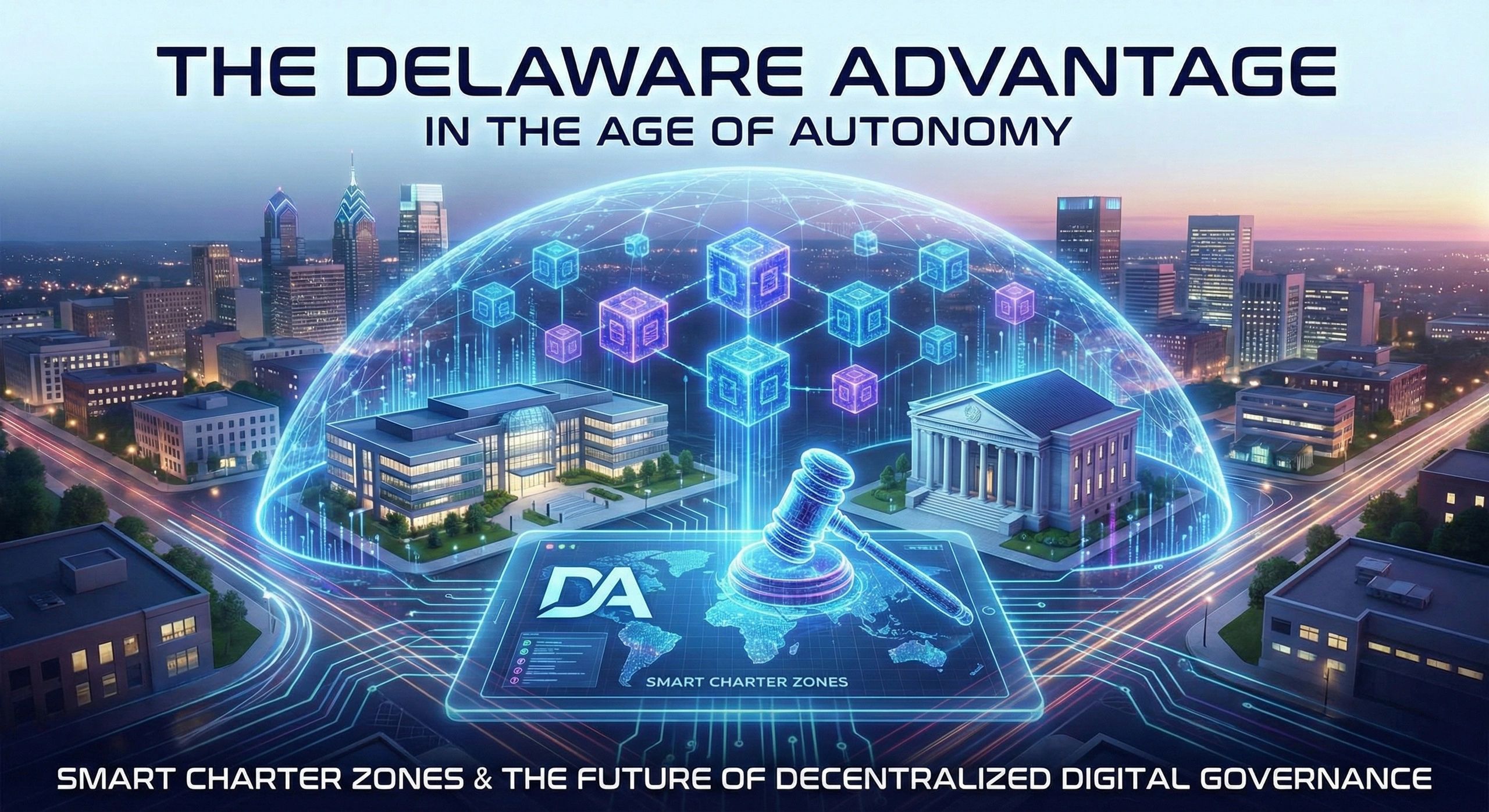
The Delaware Advantage in the Age of Autonomy
Smart Charter Zones and the Future of Decentralized Digital Governance
The convergence of blockchain technology and artificial intelligence is not merely a technological phenomenon, it is a geopolitical one. Decentralized autonomous organizations (DAOs) entities governed by immutable smart contracts on distributed ledgers now manage tens of billions in assets without traditional corporate hierarchies. Meanwhile, increasingly sophisticated AI agents, capable of autonomous negotiation, execution, and decision-making, are poised to automate vast swaths of economic activity. Together, these innovations promise a new paradigm of borderless, algorithmically enforced cooperation. Yet they also operate in a regulatory void, exposing participants to jurisdictional arbitrage, enforcement gaps, and potential exploitation by adversarial actors (Raskin 2017; Aurum Law 2025).
The United States cannot afford to remain a bystander. Early movers such as Wyoming have granted DAOs legal personality as limited liability companies, a modest but important step (Wyoming Statute § 17-31-101 et seq., 2021; Latham & Watkins, 2024). However, Wyoming’s framework lacks the institutional depth and global credibility required to dominate at scale. Delaware, by contrast, incorporates more than one million entities and serves as the legal home to over two-thirds of Fortune 500 companies, thanks to its flexible corporate code and the unparalleled expertise of the Court of Chancery (Delaware Division of Corporations 2025; Offit Kurman 2025). This legacy positions the First State uniquely to extend its franchise into the digital era.
A forward-looking proposal now gaining traction in policy circles – championed by U.S. Senate candidate John Shulli as a cornerstone of his vision to make Delaware a “Renaissance Engine” for the twenty-first century – is the creation of Smart Charter Zones in cities such as Wilmington, Delaware (Shulli, 2026). These zones would establish Delaware as the preeminent global jurisdiction for DAO incorporation, conditioned on a modest but strategic requirement: participating entities must host a material portion of their computational infrastructure (servers and nodes) within the state. More ambitiously, the Delaware Court of Chancery – already the world’s gold standard for resolving complex corporate disputes – would explicitly extend its jurisdiction to adjudicate conflicts involving smart contracts and interactions between AI agents (Harvard Business Services 2025; Polsinelli 2025; Law Gratis 2025).
This initiative would do more than preserve Delaware’s corporate dominance; it would secure American leadership in the governance of autonomous digital systems at a moment when competitors are moving aggressively to define the rules of the next economic order.
The rise of DAOs reflects a deeper structural shift. Traditional corporations rely on hierarchical trust enforced by national legal systems. DAOs substitute cryptographic verification and automated execution, dramatically reducing transaction costs and enabling coordination among globally dispersed participants (Harvard Corporate Governance Blog 2022). When paired with AI agents – software entities that can independently negotiate, escrow funds, and enforce agreements – the result is a new form of economic organization that operates at machine speed and planetary scale (Bloomberg Law 2025).
Yet this promise carries risks. Without predictable dispute resolution, participants face uncertainty: a smart contract glitch, an AI agent misinterpretation, or a governance fork can freeze billions in value with no clear judicial recourse. Adversarial states could exploit these gaps, using anonymous DAOs to evade sanctions or launch influence operations. The United States must therefore provide a trusted, sovereign-backed forum for resolution – or watch the center of gravity shift elsewhere.
Delaware is uniquely equipped to fill this role. The Court of Chancery’s equitable jurisdiction, speedy procedures, and bench of specialist judges already attract the world’s most sophisticated corporate litigation (Cole Schotz 2025; Incserv 2024). Extending this expertise to blockchain and AI disputes would create a flywheel effect: global entities would choose Delaware charters for the certainty of adjudication by the planet’s most respected business court, reinforcing American soft power in the digital domain.
The requirement for physical server presence within Smart Charter Zones serves multiple strategic purposes. It incentivizes substantial capital investment in Delaware infrastructure – data centers, high-speed networking, and renewable energy projects – while anchoring computational power within U.S. jurisdiction. This counters the risk of critical economic activity migrating to less accountable offshore havens. It also aligns with broader national security objectives: domestic hosting facilitates oversight, reduces latency for American users, and creates high-wage technology jobs in the First State.
Critics may object that such conditionality undermines the decentralized ethos of blockchain. Yet the proposal preserves core permissionsless principles: anyone, anywhere, may participate under Delaware law. The physical presence requirement is a light touch compared with the heavy-handed industrial policies pursued by competitors in Asia and the Middle East (Foreign Affairs 2023; Foreign Affairs 2025). Delaware’s approach would combine American rule-of-law predictability with targeted incentives – a distinctly liberal strategy for technological primacy. In an era when algorithms increasingly govern commerce, the nation that governs the algorithms will shape the century. Delaware – and America – cannot afford to cede that ground.
References
Aurum Law. 2025. “Digital Cyborgs: Blockchain AI Agents Legal Structuring.” https://aurum.law/newsroom/Digital-Cyborgs-Blockchain-AI-Agents-Legal-Structuring-identity-issues
Bloomberg Law. 2025. “AI’s Leaps Forward Force Talks About Legal Personhood.” https://news.bloomberglaw.com/us-law-week/ais-leaps-forward-force-talks-about-legal-personhood-for-tech
Cole Schotz. 2025. “Delaware Chancery Court Litigation.” https://www.coleschotz.com/practices/litigation/chancery-court-litigation/
Delaware Division of Corporations. 2025. Annual Report. https://corp.delaware.gov/
Foreign Affairs. 2023. “China’s Hidden Tech Revolution.” https://www.foreignaffairs.com/china/chinas-hidden-tech-revolution-how-beijing-threatens-us-dominance-dan-wang
Foreign Affairs. 2025. “An Industrial Policy With American Characteristics.” https://www.foreignaffairs.com/united-states/industrial-policy-american-characteristics
Latham & Watkins. 2024. “Wyoming Adopts New Legal Structure for DAOs.” https://www.jdsupra.com/legalnews/wyoming-adopts-new-legal-structure-for-3900987/
Harvard Business Services. 2025. “What Is the Delaware Court of Chancery?” https://www.delawareinc.com/blog/what-is-the-delaware-court-of-chancery/
Harvard Corporate Governance Blog. 2022. “A Primer on DAOs.” https://corpgov.law.harvard.edu/2022/09/17/a-primer-on-daos/
Incserv. 2024. “The Delaware Court of Chancery: History and Purpose.” https://incserv.com/blog/delaware-court-of-chancery-history-and-purpose/
Law Gratis. 2025. “Smart Contracts Disputes.” https://www.lawgratis.com/blog-detail/blockchain-smart-contract-patent-disputes
Offit Kurman. 2025. “Why Delaware Is a Top Choice for Business Formation.” https://www.offitkurman.com/offit-kurman-blogs/delaware-business-formation-advantages
Polsinelli. 2025. “Delaware Court of Chancery.” https://www.polsinelli.com/delaware-court-of-chancery
Raskin, Max. 2017. “The Law and Legality of Smart Contracts.” https://georgetownlawtechreview.org/wp-content/uploads/2017/05/Raskin-1-GEO.-L.-TECH.-REV.-305-.pdf
Shulli Platform. 2026. “Freedom to Achieve the American Dream.” https://shulli.org/platform
Wyoming Statute § 17-31-101 et seq. 2021. https://law.justia.com/codes/wyoming/title-17/chapter-31/article-1/section-17-31-101/
Frequently Asked Questions
What are Smart Charter Zones? Smart Charter Zones are specially designated areas in Delaware (starting with Wilmington) designed to make the First State the global leader in the Age of Autonomy. Under this proposal, DAOs, AI companies, and blockchain projects can incorporate under Delaware law while agreeing to host a material portion of their computational infrastructure (servers and nodes) within the state. This creates a powerful “flywheel” of investment, jobs, and legal certainty.
How would the Court of Chancery handle disputes involving AI agents or smart contracts? The Delaware Court of Chancery — already the world’s most respected business court — would explicitly extend its jurisdiction to resolve conflicts involving smart contracts, AI agent decisions, governance forks, and algorithmic disputes. Its specialist judges, equitable principles, and speedy procedures would give participants the same predictable, high-quality adjudication that has made Delaware the incorporation capital of the world for over a century.
Why should a DAO or AI startup incorporate in Delaware instead of Wyoming or offshore jurisdictions? Delaware already incorporates more than one million entities and serves as the legal home to two-thirds of the Fortune 500, thanks to its flexible corporate code and unparalleled Court of Chancery expertise. Wyoming’s DAO framework is a positive first step but lacks the institutional depth, global credibility, and judicial sophistication required at scale. Offshore jurisdictions offer even less protection and expose projects to serious enforcement and reputational risks.
What are the economic benefits of requiring servers to be hosted in Delaware? Hosting computational infrastructure in Smart Charter Zones would drive major capital investment in data centers, high-speed networking, and renewable energy projects. It would create high-wage technology jobs in Delaware while anchoring critical digital infrastructure inside U.S. jurisdiction — delivering both economic growth and strategic advantage.
How does this proposal protect U.S. national security? By requiring a meaningful U.S. physical presence for participating entities, Smart Charter Zones reduce the risk of critical economic activity migrating to adversarial or unregulated offshore havens. Domestic hosting enables better oversight, lowers latency for American users, and supports broader national security goals around data sovereignty and technological leadership.
Is the Smart Charter Zones concept compatible with the decentralized ethos of blockchain? Yes. The proposal preserves core permissionless principles — anyone, anywhere, can still participate under Delaware law. The physical infrastructure requirement is a light-touch condition compared with the heavy-handed industrial policies of competitors in Asia and the Middle East. It combines American rule-of-law predictability with targeted incentives for domestic investment.
Who is proposing Smart Charter Zones? John Shulli, candidate for U.S. Senate from Delaware, has made Smart Charter Zones a cornerstone of his vision to transform Delaware into a “Renaissance Engine” for the 21st century. The idea builds on Delaware’s historic strengths while preparing the state — and the nation — to lead in the emerging era of autonomous systems, DAOs, and AI-driven commerce.