Single-Party Rule Promotes Managed Scarcity
Democratic Dominance in the First State Prioritizes Crisis Mitigation Over Transformative Growth
Delaware’s storied corporate franchise and pragmatic political tradition, has long exemplified moderate, business-friendly governance. However, under prolonged single-party Democratic control – marked by a gubernatorial seat held since 1993 and legislative control since 2009 – Dover has increasingly adopted a posture of scarcity management rather than ambitious expansion.
Governor Matt Meyer’s administration, facing fiscal pressures and cost-of-living challenges, has centered its agenda on affordability initiatives and social supports, often reliant on federal transfers. This approach, while responsive to immediate constituent needs, reflects a deeper dynamic of one-party dominant systems. The substitution of external blame for internal accountability, and the prioritization of redistributive relief over self-sustaining growth.
Meyer’s tenure illustrates this shift. His fiscal year 2026 budget amendments emphasized investments in education aid, Medicaid expansions, rental assistance, and homelessness programs – measures designed to alleviate household burdens amid rising costs. Housing policy, a cornerstone of his platform, has focused on tenant protections, subsidized access, and incremental supply incentives through bipartisan legislation easing regulatory barriers. Healthcare initiatives, including medical debt relief and access enhancements, similarly target symptom relief. These efforts frame governance as a bulwark against “affordability crises,” with rhetoric attributing pressures to national forces – such as federal tax policies or potential cuts to entitlements – rather than long-term state spending trajectories.
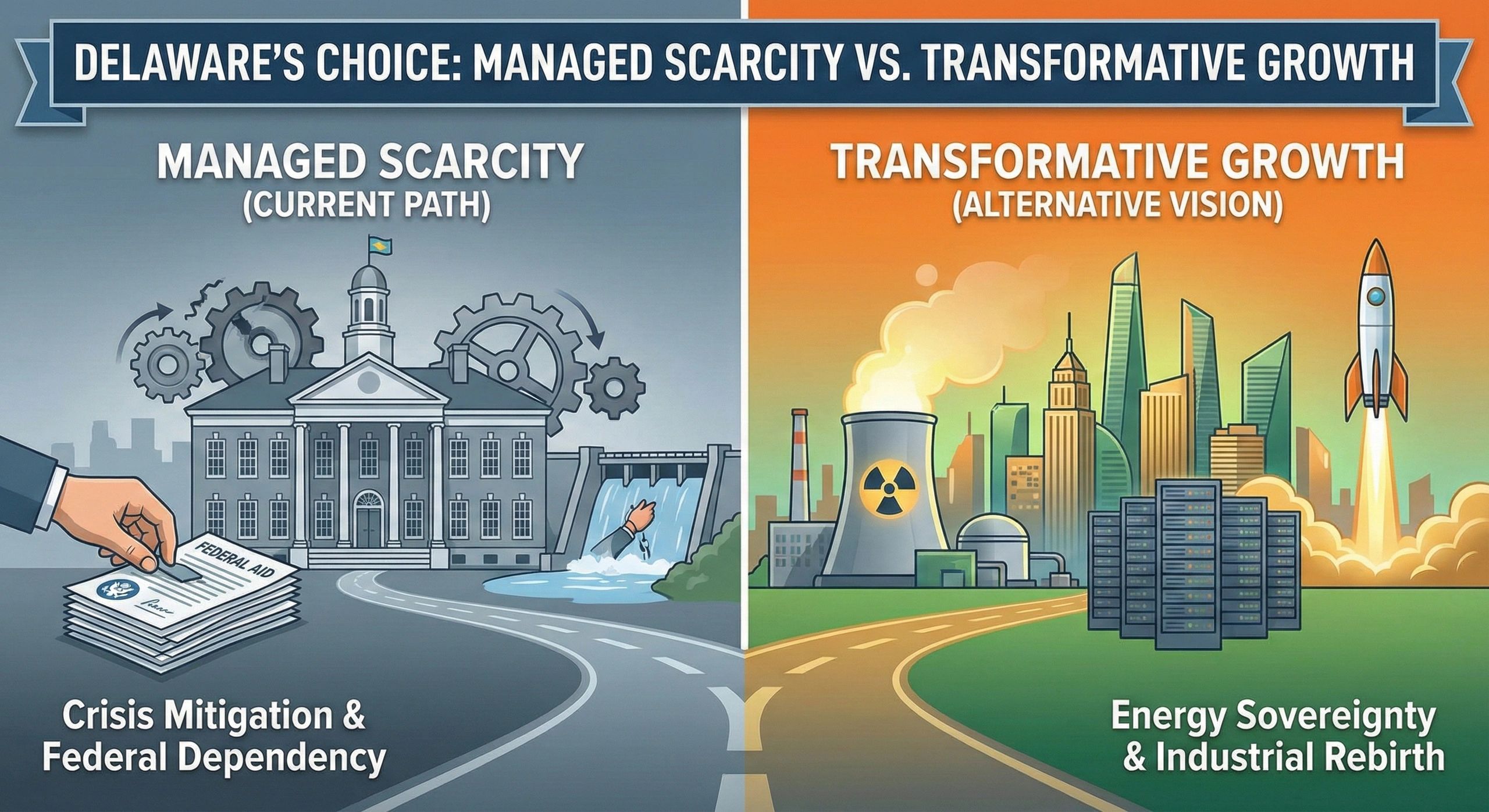
This dependency on federal funding underscores the scarcity paradigm. Meyer’s administration has repeatedly prepared for shortfalls in programs like Medicaid, SNAP, and housing grants, even declaring emergencies to bridge temporary lapses with state resources (Meyer, 2025). Such contingencies highlight a structural vulnerability that years of programmatic expansion, facilitated by limited partisan opposition, have created fiscal exposures masked by transient federal aid (Caesar Rodney Institute, 2025). Expanding commitments without corresponding revenue necessitates an “affordability” narrative that externalizes blame, preserving political cohesion within the dominant party.
In contrast to this managed decline, an alternative vision emerges, rooted in energy sovereignty, technological renaissance, and industrial rebirth. Delaware’s geographic assets – legacy industrial sites, transmission infrastructure, and judicial preeminence – position it uniquely for leadership in nuclear-powered data centers, AI innovation hubs, and digital finance (Shulli, 2026a). By decoupling from volatile regional grids, procuring small modular reactors, and establishing “Smart Charter Zones” for decentralized autonomous organizations, the state could attract hyperscale investment, generate abundant revenue, and reduce reliance on federal transfers (Shulli, 2026b). This “Renaissance Engine” framework – integrating baseload power, computational capacity, and legal incentives – offers a replicable model for escaping vassalage to external markets and fostering endogenous prosperity (Shulli, 2026c).
Democrats’ reluctance to transform is a signal of a system failure or colloquially known as “the Delaware Way.” The system deflects accountability while incentivizing incremental relief over disruptive reform. Delaware’s voters, confronting stagnant wages and eroding industrial vitality, deserve a choice beyond scarcity management. As the 2026 Senate race looms, the contest pits affordability politics against pro-growth initiatives – one that could restore the First State’s independence and serve as a national exemplar.
References
Caesar Rodney Institute. (2025). Delaware’s Budget Woes, https://www.caesarrodney.org/post/delaware-s-budget-woes-a-crisis-made-in-dover-not-washington
Meyer, M. (2025). Emergency declarations and federal funding contingencies. Office of the Governor. https://governor.delaware.gov/state-of-emergency/declaration-of-a-state-of-emergency-in-the-state-of-delaware-due-to-the-interruption-of-federal-snap-benefits/
Shulli, J. A. (2026a). Pivot from corporate law to energy sovereignty: The First State’s last chance. https://shulli.org/articles/f/the-first-states-last-chance
Shulli, J. A. (2026b). The Renaissance Engine: Powering the next era of human progress. https://shulli.org/articles/f/the-renaissance-engine
Shulli, J. A. (2026c). Delaware smart charter zones: Positioning the United States as the global hub for DAOs and AI agents. https://shulli.org/articles/f/the-delaware-advantage-in-the-age-of-autonomy