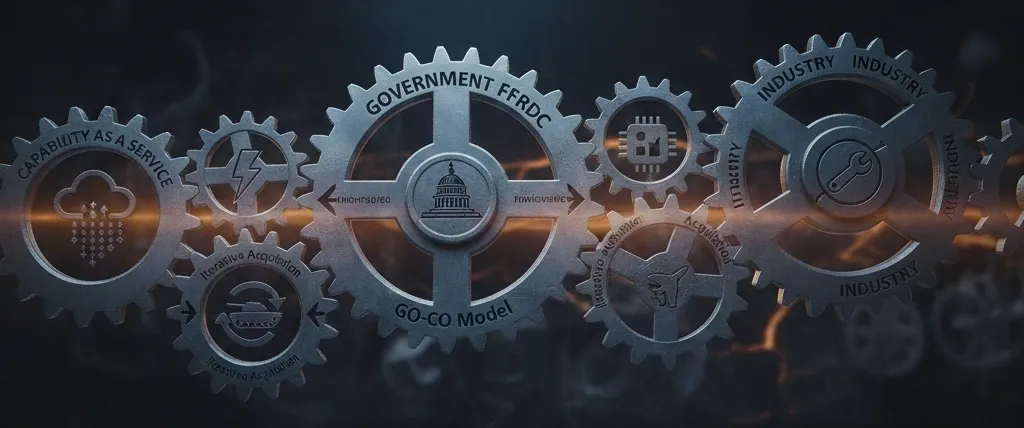
Capability as a Service
A New Paradigm for Defense Acquisition via Manufacturing-Enabled FFRDCs
Executive Summary
The United States Department of War (DoW) faces a strategic imperative to reform its acquisition system. For decades, this system has been plagued by persistent, systemic failures, including chronic cost overruns, debilitating schedule delays, and a stifled innovation ecosystem that struggles to keep pace with the speed of technological change and the urgency of emerging geopolitical threats. As documented extensively by the Government Accountability Office (GAO) and other oversight bodies, the current linear, requirements-driven acquisition model is a relic of a previous era, ill-suited for the dynamic challenges of the 21st century. It routinely takes over a decade to deliver an initial capability to the warfighter, by which time the technology may already be approaching obsolescence. This reality is untenable in an era of renewed great power competition.
Incremental reforms have repeatedly proven insufficient, often serving as mere workarounds to a fundamentally broken structure. A comprehensive overhaul is required – one that addresses the root causes of failure: a rigid, sequential development process; a consolidated and fragile defense industrial base (DIB); misaligned incentives that foster vendor lock-in; and a focus on procuring static platforms rather than dynamic, evolving capabilities.
Now is the time to explore a novel paradigm for defense acquisition designed to overcome these deep-seated challenges. The proposed model is a holistic framework built on a series of interconnected legal, structural, and procedural reforms. Its central premise is a fundamental shift from purchasing specific military platforms (e.g., a tank or aircraft) to subscribing to enduring military capabilities (e.g., ground dominance or air superiority). This “Capability as a Service” (CaaS) model would be enabled by the following foundational changes:
- Legislative Reform: Congress would pass targeted legislation to amend Federal Acquisition Regulation (FAR) 35.017, lifting the long-standing prohibition that prevents Federally Funded Research and Development Centers (FFRDCs) from engaging in manufacturing. This change would activate a dormant provision within the existing legal framework, creating a new class of public-interest industrial entities.
- Structural Innovation: A new series of FFRDCs would be established, specifically chartered for advanced manufacturing and capability sustainment. These entities would be structured under a “Government-Owned, FFRDC-Operated” (GO-FO) model, a hybrid that combines the public asset control of the traditional Government-Owned, Contractor-Operated (GOCO) system with the non-profit, mission-driven ethos of an FFRDC. This structure ensures that critical industrial assets remain under public ownership while being operated by an entity whose primary incentive is mission success, not shareholder profit.
- Methodological Modernization: These new GO-FOs would operate using modern Iterative Acquisition Practices, such as those codified in DoW’s Adaptive Acquisition Framework (AAF). By employing Agile development, DevSecOps, and continuous user feedback, these centers would develop, produce, and upgrade capabilities in rapid, iterative cycles, breaking the traditional linear acquisition timeline.
- Business Model Transformation: DoW would procure capabilities from these GO-FOs through subscription-based CaaS agreements. This model provides predictable, recurring funding streams and contractually obligates the provider to deliver a specified level of performance and to continuously modernize the underlying technology to meet evolving threats. Obsolescence of a specific piece of hardware becomes a routine operational detail for the provider, not a strategic crisis for the DoW.
This report provides an analysis of this proposed paradigm. It examines the systemic failures of the current system, deconstructs the legal and historical basis for the proposed changes, details the operational and economic mechanics of the GO-FO and CaaS models, and conducts a comprehensive assessment of the potential benefits and risks. The analysis concludes that while the political and financial hurdles to implementation are substantial, the GO-FO CaaS model offers a coherent, integrated, and strategically necessary solution to the enduring crisis in defense acquisition. It represents a viable path toward creating a more agile, innovative, and cost-effective acquisition ecosystem capable of delivering adaptable, continuously evolving military capabilities at the speed of relevance. The report concludes with a phased implementation roadmap and a series of actionable policy recommendations for Congress and the Department of Defense.
The Imperative for Reform
Systemic Failures in the Current Defense Acquisition Model
The call for a fundamental restructuring of DoW’s acquisition system is not a new phenomenon; it is a persistent echo in the halls of Congress and the Pentagon, driven by decades of well-documented under-performance. However, the contemporary strategic environment, defined by the rapid technological advancements of peer competitors and the imperatives of the 2022 National Defense Strategy, has transformed this chronic issue into an acute national security vulnerability.(1) The current system, largely a product of the Cold War, is characterized by processes that are too slow, too costly, and too rigid to deliver the decisive advantages required for modern warfare. Despite numerous reform efforts, the core problems remain deeply entrenched, suggesting that they are not mere symptoms of mismanagement but emergent properties of a flawed system. A structural overhaul is no longer an option to be considered but a necessity to be implemented.
A Decades-Long Crisis: Chronic Cost Overruns and Schedule Delays
The most visible and consistently criticized failures of the DoW acquisition system are its chronic inability to control costs and adhere to schedules. Since 1990, the Government Accountability Office (GAO) has designated DoW weapon systems acquisition as a “high-risk” area for the federal government, a designation it retains to this day due to persistent issues of fraud, waste, abuse, and mismanagement.(1) This is not a problem of isolated program failures but a systemic condition that affects the entire portfolio of Major Defense Acquisition Programs (MDAPs).
The scale of this problem is staggering. In its June 2025 annual assessment, the GAO reported that the DoW plans to invest nearly $2.4 trillion to develop and acquire just 106 of its most expensive weapon programs.(1) The costs for these programs consistently grow far beyond their initial estimates. For example, an analysis of 30 MDAPs that were also reviewed in the previous year’s report found that their combined total cost estimates had increased by $49.3 billion – an 8.3 percent rise in a single year. A significant portion of this increase, over $36 billion, was attributed to the Air Force’s Sentinel missile program alone, which breached its critical cost growth threshold in January 2024.(3) This pattern of cost growth is a historical constant; studies have shown that defense acquisition contracts have an average cost overrun of 40 percent, and that once a contract is 15 percent complete, it is highly unlikely to recover from an overrun.(5)
These cost overruns are inextricably linked to profound schedule delays. The GAO’s 2025 report found that the expected time frame for an MDAP to deliver even an initial capability to the warfighter has now stretched to an average of almost 12 years from the program’s official start.(2) Such protracted timelines are fundamentally incompatible with the pace of technological change and the need to respond to emerging threats. Historical data confirms this trend, with some automated information systems in the late 1980s experiencing delays of 3 to 7 years, and a 2010 GAO report finding that 98 MDAPs were collectively an average of 22 months behind schedule.(4)
The root causes of these persistent failures are complex and interwoven. Inaccurate initial cost estimations, often driven by political pressure to secure program funding, create unrealistic baselines from the outset.(4) The sheer technical complexity of modern weapon systems introduces unforeseen challenges.(9) Unstable funding, congressional involvement, and shifting geopolitical priorities can lead to significant changes in requirements mid-program, a phenomenon known as “requirements creep,” which is a primary driver of both cost and schedule growth.9 The case of the A-12 Avenger II program in the early 1990s serves as a stark historical example, where overly optimistic projections on cost and schedule, combined with technical difficulties, led to the program’s cancellation after billions had been spent.(6) These factors combine to create a system that consistently over-promises and under-delivers.
The Linear Acquisition Fallacy: A Process Mismatched to the Digital Age
The underlying cause of the cost and schedule pathologies described above is DoW’s deep entrenchment in a traditional, linear acquisition structure.(1) This model, often referred to as a “waterfall” process, is characterized by a rigid and sequential progression through distinct phases: analysis, design, development, integration, test, evaluation, production, and support.(11) This structure compels program managers to fix cost, schedule, and performance baselines very early in a program’s lifecycle, often before critical technologies have been fully matured or prototyped.(1)
This linear approach is a fallacy in the modern era because it locks programs into developing systems against a set of requirements that were established years, or even a decade, prior to delivery. The result is an unacceptably high risk of fielding a weapon system that is already obsolete upon arrival, its capabilities mismatched to a threat environment that has evolved dramatically during its long gestation.(2) This is particularly problematic for systems that are heavily reliant on software and cyber-physical components, where the pace of change is measured in months, not decades.
The inadequacy of this model is thrown into sharp relief when contrasted with the practices of leading commercial companies that develop and deliver complex, innovative products that integrate hardware and software. As the GAO has repeatedly found, these firms utilize iterative development cycles that involve continuous design, modeling, validation, and production.(13) This approach allows for constant user engagement and testing, enabling the product to adapt to new information and get to market quickly with a “minimum viable product” that can be improved over time.(13)
While DoW has made efforts to adopt these practices, most notably through the Adaptive Acquisition Framework (AAF) and its Software Acquisition Pathway (SWP), these reforms have been inconsistently applied and have struggled to break the institutional preference for the traditional linear model, especially for major hardware programs.(13) The result is that many of DoW’s attempts at reform remain, as the GAO notes, “largely workarounds to address problems that result from the current acquisition system, rather than enduring solutions that fix the underlying system itself”.(2) The system’s fundamental operating logic remains mismatched to the demands of the digital age.
The Fragile Industrial Base: Consolidation, Competition, and Stifled Innovation
The performance of the acquisition system is inseparable from the health and structure of the Defense Industrial Base (DIB) that supports it. A central challenge facing DoW is the dramatic consolidation of the DIB that has occurred since the end of the Cold War. In the late 1980s, there were over 50 prime defense contractors; today, that number has shrunk to fewer than 10, with some analyses putting the number of top-tier prime contractors for major weapon systems at just five.(15) This consolidation, initially encouraged by the Pentagon to ensure the survival of key firms amidst declining budgets, has led to a market structure that DoW itself now views with significant concern.(15)
This “substantial decline” in competition has several negative consequences. It reduces the industrial base’s resilience to supply chain disruptions, creates critical dependencies on a small number of suppliers, and, most importantly, stifles the innovation that competition is meant to spur.(15) When only one or two firms are capable of bidding on a multi-billion-dollar program, the government’s negotiating leverage is severely diminished, leading to increased prices and potentially lower quality.(19)
Compounding this problem are the formidable barriers to entry that prevent new, innovative firms from participating in the defense market. DoW’s acquisition processes are notoriously inflexible and complex, with a heavy regulatory burden that non-traditional commercial companies are often unwilling or unable to bear.(15) This creates what financial analysts call a “wide, deep, and shark-infested moat” that protects incumbent contractors from outside competition.(15) While DoW has established organizations like the Defense Innovation Unit (DIU) to bridge this gap, these efforts operate at the margins of a system that remains overwhelmingly geared toward its traditional suppliers.(15) The result is a DIB that is increasingly isolated from the broader, more dynamic commercial economy, cutting DoW off from the very sources of innovation it needs to maintain its technological edge.(15)
The Perils of Vendor Lock-In: A Structural Impediment to Modernization
The consolidation of the DIB and the long, single-source nature of major acquisition programs create the ideal conditions for a phenomenon known as “vendor lock-in”.(22) Vendor lock-in occurs when DoW becomes dependent on a single contractor’s proprietary technology, data, or processes, making it prohibitively expensive or technically infeasible to switch to an alternative supplier for upgrades, maintenance, or follow-on production.(24)
This dependence effectively grants the incumbent vendor a monopoly over the entire lifecycle of a weapon system.(24) Once a contractor wins the initial development and production contract, they are in a position to control the costs and pace of all future sustainment and modernization efforts. This dynamic is a primary driver of the exorbitant lifecycle costs that plague many DoW programs.
Vendor lock-in is primarily enabled by the control of intellectual property (IP) and technical data. Too often in the past, DoW has failed to secure the necessary technical data deliverables and associated license rights during initial contract negotiations.(25) Without access to the detailed design data, software source code, and system interface information, the government cannot competitively bid out sustainment or upgrade contracts to other firms; it is locked into the original manufacturer.(24) This lack of data rights forces the government into a position where the incumbent can dictate terms, forcing DoW to pay whatever price is demanded for spare parts and upgrades.(24)
This structural impediment is a powerful disincentive for innovation. A locked-in vendor has little motivation to invest its own funds in significant capability enhancements, as it faces no competitive pressure to do so. Instead, it can rely on the government to fund incremental, and often costly, block upgrade programs. Vendor lock-in thus perpetuates the cycle of technological stagnation and high costs, ensuring that weapon systems are not only expensive to acquire but also to maintain and modernize throughout their decades-long service lives. Addressing this issue requires more than better contract negotiation; it requires a new acquisition structure that fundamentally changes the ownership and control of critical technologies and industrial assets.
Re-envisioning the FFRDC: From Research Center to Capability Provider
The proposal to empower Federally Funded Research and Development Centers (FFRDCs) with manufacturing capabilities represents a radical departure from their historical role. To be viable, this concept requires a thorough understanding of the FFRDC model, a precise deconstruction of the legal barriers that currently prevent such a role, and a credible strategy for preserving the core mission of these unique institutions. The existing legal framework, while restrictive, contains within it the very mechanism for its own amendment, suggesting that the primary obstacle is the political will to enact change. By transforming the nature of the FFRDC’s relationship with the end product, the proposal seeks not to corrupt their mission of objectivity but to ground it in the tangible delivery of performance, thereby creating a new and more potent form of public-interest accountability.
The FFRDC Model: A Unique Public-Private Partnership
FFRDCs are a distinct class of public-private partnerships, established to meet special, long-term research and development needs of the U.S. government that cannot be met as effectively by either in-house government resources or traditional for-profit contractors.(27) There are currently 42 FFRDCs sponsored by various federal agencies, including the Department of War, the Department of Energy, and NASA, performing work in areas ranging from national security and systems engineering to health and atmospheric sciences.(27)
The defining characteristic of an FFRDC is its “special relationship” with its government sponsor, a relationship codified in the Federal Acquisition Regulation (FAR).(28) This special status grants FFRDCs access beyond that of a normal contractual relationship, including to sensitive government and supplier data, government facilities, and key personnel.(28) This privileged access is essential for FFRDCs to perform tasks that are integral to the mission of their sponsoring agency, often involving work closely associated with inherently governmental functions.(30)
In exchange for this access, FFRDCs are held to a higher standard of conduct. They are required to operate in the public interest with objectivity and independence, to be free from organizational conflicts of interest, and to provide full disclosure of their affairs to their sponsoring agency.(28) This is the core of the FFRDC bargain. Their genesis in the aftermath of World War II was driven by the need to create and sustain centers of technical excellence that were insulated from both the restrictions of the civil service and the profit-driven motives of the commercial marketplace.(27) This unique structure allows them to attract and retain highly skilled technical talent and provide unbiased, long-term strategic advice to the government.(29)
The Legislative Hurdle: Deconstructing the FAR 35.017 Manufacturing Prohibition
The most significant barrier to the proposed model is the explicit prohibition on manufacturing found within the regulations that govern FFRDCs. Federal Acquisition Regulation Part 35.017, which sets forth the policy for establishing and using FFRDCs, contains a clear and direct constraint. Specifically, FAR 35.017-2(i) stipulates that for an FFRDC to be established, the sponsor must ensure that “Quantity production or manufacturing is not performed unless authorized by legislation”.(34) This single clause is the legal linchpin that must be addressed for the proposed reform to proceed.
The original intent behind this prohibition is central to the FFRDC concept. It was designed to prevent two primary issues. First, it ensures that FFRDCs do not leverage their privileged access to government data and facilities to compete unfairly with private industry.(28) Second, and more fundamentally, it safeguards their objectivity and freedom from organizational conflicts of interest.(30) The principle is that an organization cannot provide impartial advice on which systems the government should acquire if it also stands to profit from manufacturing and selling those same systems.(30) This distinction – that FFRDCs neither market nor manufacture – lies at the very heart of their traditional role as trusted, independent advisors.(30)
However, the regulatory language itself provides the pathway for change. The inclusion of the phrase “unless authorized by legislation” is not accidental; it is a deliberate acknowledgment by the framers of the regulation that circumstances could arise where Congress might deem it necessary and in the public interest for an FFRDC to undertake a manufacturing role.(34) This transforms the problem from one of overcoming a legal impossibility to one of building the political consensus necessary to pass such legislation. The primary vehicle for such a change would likely be the annual National Defense Authorization Act (NDAA), which Congress frequently uses to direct modifications to the FAR and implement new procurement policies.(39) The process for amending the FAR is well-established, involving either a congressional mandate or a regulatory process led by the FAR Council, which consists of the DoW, the General Services Administration (GSA), and the National Aeronautics and Space Administration (NASA).(41) Therefore, a clear and feasible legislative pathway exists to authorize this new mission for FFRDCs.
Preserving the Mission: Mitigating Conflicts of Interest in a Manufacturing Role
Permitting FFRDCs to manufacture products necessitates a re-evaluation of how their core mission of objectivity is maintained. The traditional conflict of interest arises from a paradigm where an FFRDC advises the government on acquiring a system that a separate, for-profit entity will manufacture. In this scenario, if the FFRDC were also the manufacturer, its advice would be inherently biased toward its own products.
The proposed model fundamentally alters this dynamic. In a Government-Owned, FFRDC-Operated (GO-FO) structure delivering a capability as a service, the traditional conflict of interest is transformed. The FFRDC operator is not competing in an open market to sell a product for profit. Instead, it is acting as a steward of a public asset, with its success measured by mission performance and capability delivery, not by profit margins or shareholder returns. The “profit” generated by its operations would be reinvested into research, modernization, and enhancing the capability it provides, as directed by its sponsoring agreement.(32)
A critical safeguard in this new model is the organizational structure of the FFRDC administrators themselves. The vast majority of FFRDCs are operated by universities or other non-profit organizations.(28) This non-profit status is a cornerstone of their ability to operate in the public interest, free from the pressures of commercial shareholders that drive the behavior of traditional defense contractors.(30) By mandating that these new manufacturing-capable FFRDCs also be operated by non-profit entities, the system retains this essential characteristic. The FFRDC’s incentive structure is aligned with its government sponsor’s long-term strategic goals, not with short-term financial gains.
Furthermore, this new role could, in fact, lead to a more potent and practical form of objectivity. The traditional FFRDC model can sometimes be criticized for producing “ivory tower” analyses that are technically elegant but disconnected from the harsh realities of manufacturing, sustainment, and operational use. By making the FFRDC responsible for the entire capability lifecycle – from initial research through production, deployment, and continuous upgrades – its technical advice and design decisions are no longer theoretical. They are directly and immediately tested against the reality of what can be built, fielded, and sustained effectively. This creates a powerful feedback loop that grounds the FFRDC’s work in tangible outcomes, fostering a new kind of “outcome-based objectivity” that may be even more valuable to DoW than the purely analytical objectivity of the traditional model.
The GOCO-FFRDC Hybrid: A Structural Foundation for the New Model
To operationalize the concept of a manufacturing-capable FFRDC, a new structural foundation is required. This foundation can be created by merging two proven public-private partnership models: the Government-Owned, Contractor-Operated (GOCO) model and the FFRDC model. This hybrid, which can be termed a “Government-Owned, FFRDC-Operated” (GO-FO) entity, is designed to leverage the strengths of both parent structures. It combines the strategic public ownership of industrial assets inherent in the GOCO model with the public-interest, mission-focused, non-profit operational ethos of an FFRDC. This synthesis creates a novel organizational structure uniquely optimized for developing, producing, and sustaining critical national security capabilities in a manner that aligns operator incentives directly with the long-term interests of the government.
The Government-Owned, Contractor-Operated (GOCO) Model: Precedent and Advantages
The GOCO model is not a new concept; it is a well-established strategy that has been successfully utilized by the U.S. government for decades, particularly in sectors requiring large-scale, specialized industrial capacity for national security purposes.(44) The model is straightforward: the government owns the physical infrastructure – the land, buildings, and critical equipment – while a private-sector firm is contracted to operate and manage the facility to produce goods for the government.(45)
The history of the GOCO model dates back to World War II, when it was used to rapidly build up the materiel production necessary for the war effort.(44) Its most famous application was in the Manhattan Project, where facilities like Los Alamos National Laboratory were government-owned but operated by a consortium of partners to produce the nation’s nuclear arsenal – a practice that continues to this day within the Department of Energy.(47) DoW has also maintained GOCO facilities for the production of munitions and aircraft. A prominent example is Air Force Plant 4 in Fort Worth, Texas, a GOCO facility that has produced numerous bomber and fighter aircraft and is currently leased to Lockheed Martin for the manufacturing of the F-35.(44)
The GOCO model offers several distinct advantages over a purely contractor-owned system (Contractor-Owned, Contractor-Operated, or COCO):
- Government Retains Control of Strategic Assets: The most critical advantage is that the taxpayer-funded capital asset – the factory – remains the property of the U.S. government. This prevents a scenario where a private firm, having built a facility with public funds, could repurpose it for other uses or exit the business entirely, leaving the government vulnerable.(47)
- Increased Production and Surge Capacity: Government ownership allows for the deliberate design of facilities with excess capacity that can be quickly mobilized in a national emergency, a key requirement for industrial readiness that for-profit firms are not incentivized to build on their own.(44)
- Lowered Barriers to Entry and Increased Competition: The government’s assumption of the massive upfront capital investment required for advanced manufacturing facilities removes a primary barrier to entry. This allows a wider range of firms, including smaller and non-traditional companies, to compete for the contract to operate the facility, fostering competition and driving performance.(44)
- Focus on Core Competencies: The model allows each partner to focus on what it does best. The government invests taxpayer funds to safeguard national security and create industrial capacity, while the private-sector operator applies its expertise and business acumen to efficiently produce the required weapon systems.(44)
Designing the GO-FO: A New Public-Private Partnership for Manufacturing
The proposed “Government-Owned, FFRDC-Operated” (GO-FO) model is a direct evolution of the traditional GOCO structure. It retains the core principle of public ownership of industrial assets but replaces the for-profit commercial operator with a non-profit FFRDC. This single substitution is designed to resolve the primary tension inherent in the traditional GOCO model: the potential misalignment of incentives between the government owner and the for-profit operator.
In a standard GOCO arrangement, the contractor’s primary fiduciary duty is to its shareholders, which can conflict with the government’s long-term strategic objectives. For instance, a for-profit operator has little financial incentive to invest in or maintain surge production capacity that sits idle during peacetime, as this represents a non-revenue-generating capital cost.(44) Similarly, their motivation for long-term investment in facility modernization may be limited to the terms of the current operating contract.
By contrast, an FFRDC operator’s core mission is to serve the public interest and meet the long-term needs of its government sponsor.(30) Its success is not measured in quarterly profits but in its ability to deliver on its chartered mission. A GO-FO model, therefore, aligns the operator’s incentives directly with the government’s strategic goals. The FFRDC operator would be intrinsically motivated to maintain surge capacity, proactively pursue technological upgrades, and manage the facility as a long-term national asset, because doing so directly fulfills its public-interest mandate.
The operational relationship would be clearly defined. DoW, as the owner, would be responsible for the initial funding, construction, and capitalization of the physical plant, including advanced manufacturing equipment, test ranges, and digital infrastructure. A newly chartered FFRDC, selected through a competitive process, would serve as the exclusive operator of that facility under a long-term (e.g., five-year, renewable) sponsoring agreement. This FFRDC would be responsible for all aspects of the capability lifecycle within the facility, including research and development, systems engineering, production, quality control, sustainment, and continuous modernization.
Economic and Logistical Feasibility: Establishing New National Assets
The establishment of a new series of GO-FO facilities would represent a major national industrial policy initiative, requiring significant upfront investment and careful logistical planning. The costs associated with building new, state-of-the-art advanced manufacturing plants are substantial. Based on current data, startup costs for a large-scale manufacturing business can range from several hundred thousand to well over $10 million, with costs for specialized aerospace and defense facilities being significantly higher.(48) Construction spending for manufacturing facilities has surged in recent years, driven by policy initiatives like the CHIPS Act, with investments in single projects running into the billions of dollars.(49) A realistic estimate for a single, comprehensive GO-FO facility capable of producing a complex weapon system would likely be in the low billions of dollars, with an establishment timeline of several years.
While significant, this investment must be viewed in the context of the nearly $2.4 trillion DoW already plans to spend on its costliest weapon programs, many of which are plagued by cost overruns that can themselves run into the billions.1 The upfront capital investment in a GO-FO facility could be offset over the long term by the avoidance of such overruns and the reduction in lifecycle sustainment costs.
The logistical feasibility of establishing these new national assets depends on strategic site selection. Drawing on recommendations for creating new aircraft GOCO facilities, several key criteria must be considered (44):
- Workforce Access: Proximity to a population center with a deep pool of skilled labor in engineering, software development, and advanced manufacturing trades is essential.
- University Partnerships: Co-location near a major research university can create a synergistic relationship for workforce training, R&D collaboration, and talent pipelines.
- Transportation Infrastructure: Easy access to a major airport or flight line for testing and delivery, as well as robust rail and highway access for raw materials and sub-components, is critical.
- Resilient Infrastructure: A reliable and resilient energy grid, robust digital communications infrastructure, and access to critical resources like water are foundational requirements.
The success of these facilities would depend on addressing the existing fragility of the defense supply chain. GO-FOs cannot operate in a vacuum; they will rely on a network of sub-tier suppliers for materials and components. This requires a concurrent national effort to strengthen the domestic supply chain, mitigate reliance on foreign sources for critical materials, and invest in the STEM education pipeline to create the next generation of the advanced manufacturing workforce.(51) The creation of GO-FOs could itself be a catalyst for this revitalization, providing a stable, long-term demand signal for a new ecosystem of innovative sub-tier suppliers.
From Platforms to Performance: Implementing Capability as a Service (CaaS)
The structural innovation of the Government-Owned, FFRDC-Operated (GO-FO) model provides the “how,” but the “what” and “why” of this new acquisition paradigm are defined by the business model it enables: Capability as a Service (CaaS). This model represents a fundamental shift in DoW’s procurement philosophy, moving away from the traditional acquisition of physical platforms and toward the subscription to guaranteed operational outcomes. By learning from the mature “as-a-service” models that have revolutionized the commercial technology sector, DoW can reframe its relationship with its capability providers. This new relationship, powered by the engine of iterative development, focuses on performance, adaptability, and continuous modernization, directly addressing the core failures of the current platform-centric acquisition system.
Defining Capability as a Service (CaaS) for Defense
In the context of national defense, Capability as a Service is a delivery model where DoW purchases a subscription to achieve a desired military effect, under specified standards and conditions, through a combination of means and ways to perform a set of tasks.(54) Instead of buying a specific piece of hardware, DoW buys the outcome that the hardware, software, and supporting elements are intended to produce.(56)
The contrast with the traditional model is stark. For example, instead of launching a multi-decade program to design, develop, and procure a new model of unmanned aerial vehicle (UAV), DoW would subscribe to a “Persistent Aerial Intelligence, Surveillance, and Reconnaissance (ISR) Capability” for a specific geographic region. The CaaS provider- in this case, the GO-FO – would be contractually obligated to deliver a certain number of flight hours, with a specified sensor resolution, data latency, and operational availability, for a fixed recurring fee.(58)
Under this model, the value is in the service delivered, not the physical hardware.(57) The GO-FO provider is responsible for the entire lifecycle of the capability. This includes designing, manufacturing, deploying, operating, maintaining, and – most critically – continuously upgrading the systems (e.g., the UAVs, ground stations, data links, and analytical software) required to meet the performance metrics of the subscription agreement.(57) The government has no sunk costs in developing the system but instead pays for the capability it provides. This incentivizes the supplier to constantly evolve its technology to improve performance and reduce its own operating costs, or risk losing the subscription contract upon renewal.(57) This model has already been piloted in concepts like the Joint Counter-small Unmanned Aircraft System (C-sUAS) Office’s (JCO) exploration of C-sUAS as a Service (CaaS), defined as a Contractor-Owned, Government-Operated provider for fixed-site protection.(58) The proposed GO-FO model would expand this concept to a Government-Owned, FFRDC-Operated framework for major capabilities.
Learning from the Commercial Sector: SaaS, PaaS, and IaaS Analogues
The CaaS concept, while novel for major defense acquisitions, is built upon decades of successful implementation in the commercial technology sector. Understanding the mature “as-a-service” cloud computing models provides a clear blueprint for how CaaS would function in a defense context. These models are typically broken down into three layers:
- Software as a Service (SaaS): This is the most visible layer and the closest analogue for DoW’s user experience under a CaaS model. In SaaS, a customer subscribes to a software application (e.g., Microsoft Office 365, Slack, Salesforce) that is accessed over the internet.(59) The customer does not own the software or manage the underlying infrastructure; they simply pay a recurring fee for access to the functionality. The SaaS provider is responsible for all maintenance, updates, and security patches, ensuring the user always has the latest version.(59) Similarly, under CaaS, a military command would “log in” to a capability without needing to manage the complex logistics, maintenance, and modernization of the underlying weapon systems.
- Platform as a Service (PaaS): This layer provides a platform upon which developers can build, deploy, and manage their own applications without worrying about the underlying servers, operating systems, or databases.(62) Examples include AWS Elastic Beanstalk and Google App Engine. This is analogous to the internal environment the GO-FO would create and manage for its own engineering teams. The GO-FO would operate a PaaS to provide its developers with the tools, frameworks, and digital infrastructure needed to rapidly build and deploy the software and hardware that constitute the delivered capability.
- Infrastructure as a Service (IaaS): This is the foundational layer, providing raw, virtualized computing resources like servers, storage, and networking on a pay-as-you-go basis.(65) IaaS is analogous to the physical, government-owned assets that the GO-FO would operate. The government would provide the “infrastructure” – the factories, machinery, and test ranges – and the GO-FO would use that infrastructure to build and run its “platform” for developing and delivering the “service” or capability to the warfighter.
By adopting this layered, service-oriented mindset, DoW can leverage a proven business and technology architecture that promotes flexibility, scalability, and cost-efficiency.(61)
The Engine of CaaS: Iterative Acquisition and Continuous Development
The CaaS model is not merely a contracting mechanism; it is an operational concept that is only made possible by a modern, iterative approach to development and acquisition. The engine that powers CaaS is the set of principles and practices codified in DoW’s own Adaptive Acquisition Framework (AAF), particularly the Software Acquisition Pathway (SWP).(11)
SWP is designed specifically to “facilitate rapid and iterative delivery of software capability to the user”.(69) It integrates modern software development practices like Agile, Development, Security, and Operations (DevSecOps), and Lean methodologies.(11) These practices emphasize the use of small, cross-functional teams that work in short cycles (or “sprints”) to develop, test, and deliver small increments of functionality. This allows for continuous feedback from end-users, ensuring that the capability being developed is constantly aligned with their evolving needs.(13)
In the proposed GO-FO CaaS model, these iterative practices would be applied not just to software, but to the entire cyber-physical system that delivers the capability. The GO-FO would be structured to continuously develop and field upgrades to its hardware, firmware, and software in response to direct feedback from warfighters and new intelligence on emerging threats. The traditional, static requirements document would be replaced by a dynamic Capability Needs Statement (CNS), a high-level document that outlines operational needs and priorities but affords the development team the flexibility to evolve the technical solution over time.(72)
This creates a powerful synergy. The CaaS subscription model provides the contractual and financial framework that demands continuous improvement, while the iterative acquisition methodology provides the operational process that delivers that continuous improvement. The GO-FO’s ability to constantly enhance the capability it provides becomes its primary value proposition, ensuring DoW is not locked into a technology that was defined a decade ago, but is instead subscribed to a capability that is always at the cutting edge. This fundamentally reframes the concept of obsolescence. In the traditional model, a platform becomes obsolete and must be replaced through another decade-long acquisition program.(2) Under CaaS, the capability is enduring, while the underlying technology is expected to become obsolete and is continuously replaced as an integral part of the service. The programmatic disruption of replacing an entire weapon system is replaced by the routine operational process of upgrading components.
Comprehensive Analysis of Impacts, Benefits, and Risks
The proposal to establish a new ecosystem of Government-Owned, FFRDC-Operated (GO-FO) entities delivering capabilities as a service represents a fundamental re-architecture of the defense acquisition system. Such a profound change carries with it a wide spectrum of potential benefits and significant risks. A comprehensive analysis is required to weigh the transformative potential of this model against the substantial economic, political, and institutional challenges of its implementation. This section provides a multi-faceted evaluation, examining the model’s potential to resolve long-standing acquisition failures while also addressing the risks of industrial base disruption, the creation of new monopolies, and the complexities of governance and oversight.
Potential Benefits: A Paradigm Shift in Performance
The GO-FO CaaS model is designed to directly address the root causes of failure in the current acquisition system. If successfully implemented, it offers a suite of powerful benefits that could lead to a paradigm shift in performance.
- Accelerated Capability Delivery: By breaking free from the rigid, linear acquisition process, the model promises to dramatically shorten timelines. The use of iterative development methodologies, proven in the commercial sector and adopted by DoW’s Software Acquisition Pathway, allows for the rapid fielding of a Minimum Viable Product or initial capability, often in less than two years, followed by continuous, incremental upgrades.(13) This would be a stark contrast to the current average of nearly 12 years for an MDAP to deliver its first capability, a timeline that is dangerously out of sync with the pace of modern threats.(2)
- Enhanced Cost Control and Predictability: The subscription-based CaaS model transforms the financial profile of defense acquisition. It replaces the massive, unpredictable, and often-overrun upfront procurement costs of traditional programs with stable, predictable, recurring operating expenses, similar to a commercial SaaS subscription.(60) This provides DoW and congressional appropriators with much greater budgetary certainty and helps to smooth out the “boom and bust” cycles in defense spending that contribute to industrial base fragility.(4) The model’s incentive structure, which rewards the GO-FO for efficiency, also creates downward pressure on long-term costs.
- Fostering Continuous Innovation: The CaaS model’s greatest strength may be its ability to create a virtuous cycle of innovation. The GO-FO’s existence depends on DoW’s continued satisfaction and renewal of its capability subscription. This creates a powerful, built-in incentive for the GO-FO to constantly seek out, develop, and integrate new technologies to improve performance, reduce costs, and stay ahead of adversaries.(57) This stands in direct opposition to the current model, where a prime contractor with a locked-in, long-term contract has little incentive to innovate beyond what the government explicitly funds in separate, slow-moving upgrade programs.
- Revitalizing the Industrial Base and Promoting Competition: The creation of GO-FOs would introduce a new and powerful competitive vector into the highly consolidated DIB. These entities would not be vertically integrated monoliths; rather, they would act as system integrators, constantly seeking the best sub-components and technologies from across the entire industrial base. This creates a dynamic new market for innovative small businesses and non-traditional defense contractors who can sell their products and services to the GO-FOs, breaking the oligopoly of the prime contractors.(44) This fosters a new form of competition at the sub-system level, driving innovation from the bottom up.
- Strengthening Government Control and Mitigating Vendor Lock-In: The GO-FO structure directly confronts the problem of vendor lock-in. Because the government owns the physical production facilities and the non-profit FFRDC operates them in the public interest, the government retains ultimate control over the means of production.(47) Furthermore, the sponsoring agreement would mandate that all intellectual property and technical data developed within the GO-FO are owned by or licensed with unlimited rights to the government. This ensures the government always has the “technical data package” needed to compete future operations or sustainment, completely breaking the cycle of proprietary data lock-in that plagues the current system.(24)
Potential Risks and Mitigation Strategies
Despite its transformative potential, the implementation of the GO-FO CaaS model is fraught with significant risks that must be proactively managed.
- Economic Disruption to the Defense Industrial Base: This model is an existential threat to the business models of the incumbent prime contractors, who currently dominate the defense market. A shift of major acquisition programs to a GO-FO ecosystem would divert tens or hundreds of billions of dollars away from these firms. This would undoubtedly trigger intense political opposition and lobbying efforts to defeat the required legislation.(75) The disruption could also have negative effects on the broader DIB if not managed carefully, as primes are major employers and anchors of the sub-tier supply chain.(15)
- Mitigation Strategy: Implementation should be phased and strategic. The initial pilot programs should focus on new and emerging capability areas where incumbents are less entrenched, such as hypersonics, quantum computing, or autonomous systems. This “greenfield” approach minimizes direct conflict. Over the long term, a hybrid ecosystem should be envisioned where GO-FOs and traditional primes coexist, with GO-FOs sometimes acting as partners or even subcontractors to primes on very large-scale integration efforts, and primes competing to supply subsystems to GO-FOs.
- Creation of a New Government-Sponsored Monopoly: A significant risk is that a GO-FO, once established, could become a new form of inefficient, government-sponsored monopoly, insulated from the competitive pressures that drive performance.(77) Without true competition, it could become complacent, technologically stagnant, and costly, recreating the very problems it was designed to solve.(80)
- Mitigation Strategy: Competition must be designed into the model’s structure. First, the contract to operate each GO-FO facility should be competed every five years, as is the standard for FFRDCs, ensuring the operator must continuously demonstrate its value.(81) Second, wherever feasible, DoW should establish multiple, overlapping GO-FOs for similar capability domains (e.g., two different GO-FOs for unmanned systems). This creates a “yardstick competition,” where the performance and cost of one can be benchmarked against the other, providing DoW with the data and leverage needed to drive performance during subscription renewal negotiations.
- Governance and Oversight Complexity: Public-private partnerships are notoriously complex to govern and oversee.(82) The GO-FO model would require a sophisticated governance structure to manage the relationship between the government owner and the FFRDC operator, define clear performance metrics for the CaaS agreements, and ensure financial transparency and accountability. Failure to establish robust oversight could lead to inefficiency and a failure to achieve the model’s intended benefits.(84)
- Mitigation Strategy: A dedicated oversight body with deep expertise in managing complex partnerships should be established within the Office of the Under Secretary of Defense for Acquisition and Sustainment (OUSD(A&S)). Each GO-FO must have a clear, congressionally approved charter that defines its mission and scope. The CaaS subscription agreements must be built around objective, measurable, and outcome-oriented performance metrics, with clear financial incentives and penalties tied to performance.
- Political Feasibility and Industry Lobbying: The political challenge of passing the necessary legislation to amend the FAR and appropriate billions of dollars for new facility construction is immense. The powerful lobbying efforts of the established DIB, combined with institutional inertia within the DoW and Congress, represent the single greatest barrier to implementation.(75)
- Mitigation Strategy: Success requires building a broad, bipartisan coalition. The proposal must be framed not just as an acquisition reform, but as a national security imperative and a major industrial policy initiative with widespread economic benefits, including job creation, regional economic development, and STEM workforce enhancement. Securing influential champions within the House and Senate Armed Services Committees and the DoW’s senior leadership is essential.
- Scale of Implementation and Upfront Costs: The sheer scale of establishing even a single new advanced manufacturing facility, including building the physical plant, acquiring the equipment, hiring and training a workforce, and cultivating a supply chain, is a massive and expensive undertaking.(48) Attempting to do too much, too soon, could lead to failure.
- Mitigation Strategy: A phased and incremental approach is crucial. The entire concept should begin with a single, well-defined, and adequately funded pilot program. This pilot would serve as a proof of concept, allowing the DoW to test the GO-FO and CaaS models on a manageable scale, refine the governance and contracting processes, and generate concrete performance data and lessons learned before making a decision on wider implementation.
A Phased Implementation Roadmap and Policy Recommendations
The transformation from the current acquisition system to a GO-FO CaaS model is a complex, multi-decade endeavor that cannot be accomplished through a single, sweeping action. It requires a deliberate, phased implementation that builds a foundation of legal authority, demonstrates value through a carefully managed pilot program, and scales success based on empirical evidence. This section outlines a concrete, actionable roadmap for policymakers in Congress and the Department of Defense, translating the preceding analysis into a series of specific recommendations designed to de-risk this ambitious reform and maximize its probability of success.
Legislative and Policy Foundation (Years 1-2)
The initial phase is focused on creating the legal and organizational predicate for the new model. Without a firm foundation in law and policy, any subsequent efforts will fail.
- Recommendation for Congress: Authorize a Pilot Program via the NDAA. The most critical first step is for Congress to draft and pass specific legislative language in an upcoming National Defense Authorization Act (NDAA). This language must achieve two primary objectives. First, it must amend Federal Acquisition Regulation (FAR) 35.017-2(i) to create a specific, limited authority for the Secretary of Defense to establish a pilot program for FFRDC manufacturing.(34) This circumvents the need for a full, government-wide change to the FAR, focusing the authority where it is needed. Second, the legislation should clearly define the parameters of this pilot, authorizing the establishment of at least one GO-FO facility and the use of CaaS subscription contracts for its output.
- Recommendation for Congress: Authorize and Appropriate Pilot Funding. Concurrent with the legislative authority, Congress must authorize and appropriate the necessary funds for the pilot program. This includes funding for the design and construction of a new advanced manufacturing facility, the procurement of initial equipment, and the first several years of the FFRDC operator’s budget and the CaaS subscription fee. To ensure success, this funding must be stable and protected from the vagaries of the annual budget cycle, perhaps through the use of a dedicated, multi-year fund. The initial pilot should be focused on a high-priority, technologically challenging, but bounded capability area, such as Counter-Unmanned Aircraft Systems (C-UAS), tactical autonomous systems, or specialized munitions for which the current industrial base has limited capacity.
- Recommendation for DoD: Establish a Pilot Program Office. The Under Secretary of Defense for Acquisition and Sustainment (USD(A&S)) should immediately establish a dedicated Program Office to design, launch, and manage the GO-FO pilot. This office would be responsible for developing the detailed charter, governance structure, and performance metrics for the first GO-FO. It would also lead the site selection process for the new facility and manage the competition to select the FFRDC operator.
Phase 2: Pilot Program Execution (Years 2-7)
This phase moves from policy to practice, focusing on the stand-up and initial operation of the first GO-FO to generate empirical data on the model’s performance.
- Recommendation for DoD: Compete and Select the FFRDC Operator. The Pilot Program Office should conduct a full and open competition to select the non-profit administrator for the pilot GO-FO facility. The competition should be open to university consortia, existing FFRDC administrators, and other qualified non-profit organizations. The selection criteria should prioritize technical expertise in the chosen capability area, experience managing large-scale R&D enterprises, and a sound proposal for implementing iterative development practices.
- Recommendation for DoD: Oversee Facility Construction and Stand-Up. DoW, through the Program Office and in partnership with the U.S. Army Corps of Engineers or a similar entity, will oversee the construction and equipping of the pilot facility. Simultaneously, it will manage the stand-up of the FFRDC operator team, ensuring a smooth transition from the construction phase to the operational phase.
- Recommendation for DoD: Execute the First CaaS Contract. The Program Office will execute the first CaaS subscription contract with the newly established GO-FO. This contract is a critical element of the pilot and must be carefully structured. It should be based on the principles of the Software Acquisition Pathway, defining high-level capability needs via a Capability Needs Statement (CNS) rather than a rigid technical specification.(69) The contract must include clear, outcome-based performance metrics, a framework for continuous user feedback, and defined processes for the iterative delivery of capability upgrades.
- Recommendation for Congress/GAO: Mandate Independent Assessment. The authorizing legislation should mandate that the Government Accountability Office (GAO) conduct an independent, multi-year assessment of the pilot program. The GAO should be directed to evaluate the pilot’s performance against traditional acquisition programs in the same capability area, focusing on metrics of cost, schedule, performance, and adaptability. This independent evaluation is crucial for providing Congress with the objective data needed to make an informed decision about the model’s future.
Phase 3: Evaluation and Scaled Implementation (Years 8+)
Based on the results of the pilot program, this phase focuses on making a strategic decision about the future of the GO-FO CaaS model and, if successful, scaling its implementation.
- Recommendation for DoD/Congress: Strategic Decision on Scaling. Based on the GAO’s independent assessment and the DoW’s own findings, the Secretary of Defense and Congress will make a formal determination on the success of the pilot program. If the model proves to be a more effective and efficient means of delivering capability, they should jointly develop a long-term strategy to establish a series of GO-FOs for other critical military capability areas. This strategy should prioritize areas where the current DIB is most fragile, least competitive, or where the pace of technological change is most rapid.
- Recommendation for DoD: Institutionalize the Model in Policy. If the decision is made to scale, USD(A&S) should formally institutionalize the GO-FO and CaaS models within DoW acquisition policy, primarily through updates to the DoW 5000 series of directives. This would establish the GO-FO CaaS pathway as a formal option within the Adaptive Acquisition Framework, alongside the existing pathways for major capability, software, middle-tier acquisition, and others.
- Recommendation for DoD: Develop a Hybrid Industrial Base Strategy. As the GO-FO ecosystem expands, the DoW must develop a deliberate strategy for integrating these new public-interest entities with the traditional for-profit DIB. This strategy must define clear roles for collaboration, subcontracting, and competition. The goal is not to replace the private DIB entirely, but to create a healthier, more resilient, and more competitive hybrid industrial base where public and private entities work in both complementary and competitive ways to provide the best possible capabilities to the warfighter.
Concluding Argument: A Necessary Revolution for an Era of Competition
The proposal outlined in this report is undeniably ambitious. It challenges decades of acquisition orthodoxy, confronts the entrenched interests of the existing defense industrial base, and requires significant, sustained political will and financial investment. Yet, the imperative for such a revolutionary change is undeniable. The current acquisition system is a product of a different strategic era, and its persistent failures are not just a matter of fiscal waste but a direct threat to the nation’s ability to deter and, if necessary, win future conflicts.(2)
The linear processes, misaligned incentives, and consolidated industrial base of the current system are demonstrably failing to deliver capability at the speed of relevance. In an era of great power competition, where technological superiority can no longer be taken for granted, continuing with the status quo is a recipe for strategic failure.
The Government-Owned, FFRDC-Operated Capability as a Service model offers a coherent, integrated, and strategically sound alternative. It is not a panacea, but it is a holistic framework that addresses the root causes of acquisition failure. By realigning incentives toward the public interest, embracing modern iterative development methodologies, and creating a new vector for competition and innovation, this model provides a viable path toward a future where the Department of Defense can acquire and field adaptable, continuously evolving military capabilities that will provide a decisive advantage to the American warfighter for decades to come. The risks are high, but the risks of inaction are far greater.
JAS
References:
- DEFENSE ACQUISITION REFORM Persistent Challenges Require New Iterative Approaches to Delivering Capability with Speed – GAO, accessed September 7, 2025, https://www.gao.gov/assets/880/879068.pdf
- Defense Acquisition Reform: Persistent Challenges Require New Iterative Approaches to Delivering Capability with Speed | U.S. GAO, accessed September 7, 2025, https://www.gao.gov/products/gao-25-108528
- Weapon Systems Annual Assessment: DoW Leaders Should Ensure That Newer Programs Are Structured for Speed and Innovation | U.S. GAO, accessed September 7, 2025, https://www.gao.gov/products/gao-25-107569
- Cost and Time Overruns for Major Defense Acquisition Programs, accessed September 7, 2025, https://dair.nps.edu/bitstream/123456789/2493/1/CSIS-AM-11-163.pdf
- Study of Cost Overrun and Delays of Department of Defense (DoW)’s Space Acquisition Program – Scholars’ Mine, accessed September 7, 2025, https://scholarsmine.mst.edu/cgi/viewcontent.cgi?article=1721&context=engman_syseng_facwork
- An Analysis of Cost Overruns on Defense Acquisition Contracts, accessed September 7, 2025, https://www.wcu.edu/pmi/1996/J93SEP43.PDF
- GAO-25-108528 Highlights, DEFENSE ACQUISITION REFORM: Persistent Challenges Require New Iterative Approaches to Delivering Capab, accessed September 7, 2025, https://www.gao.gov/assets/gao-25-108528-highlights.pdf
- Schedule Delays and Cost Overruns Plague DoD Automated Information Systems – GAO, accessed September 7, 2025, https://www.gao.gov/products/t-imtec-89-8
- BN STUDY OF COST OVERRUN AND DELAYS OF Department of Defense (DoD)’s SPACE ACQUISITION PROGRAM, accessed September 7, 2025, https://par.nsf.gov/servlets/purl/10109924
- FAILURE IS NOT AN OPTION: A ROOT CAUSE ANALYSIS OF FAILED ACQUISITION PROGRAMS – Naval Postgraduate School, accessed September 7, 2025, https://nps.edu/documents/105938399/110483737/NPS-AM-18-011.pdf/866a838e-ec55-4d27-91e7-8eb77b667624?version=1.0
- Selecting and Transitioning Pathways | Adaptive Acquisition …, accessed September 7, 2025, https://aaf.dau.edu/aaf/selecting-a-pathway/
- Major Capability Acquisition (MCA), accessed September 7, 2025, https://aaf.dau.edu/aaf/mca/
- GAO-25-107003, DoD Acquistion Reform: Military Departments Should Take Steps to Facilitate Speed and Innovation – Government Accountability Office, accessed September 7, 2025, https://www.gao.gov/assets/gao-25-107003.pdf
- DoW Acquisition Reform: Military Departments Should Take Steps to Facilitate Speed and Innovation – GAO, accessed September 7, 2025, https://www.gao.gov/products/gao-25-107003
- Why Is the U.S. Defense Industrial Base So Isolated from the U.S. …, accessed September 7, 2025, https://www.csis.org/analysis/why-us-defense-industrial-base-so-isolated-us-economy
- GAO-24-106129, DEFENSE INDUSTRIAL BASE: DoD Needs Better Insight into Risks from Mergers and Acquisitions – Government Accountability Office, accessed September 7, 2025, https://www.gao.gov/assets/d24106129.pdf
- Defense Acquisition Reform: Background, Analysis, and Issues for Congress – EveryCRSReport.com, accessed September 7, 2025, https://www.everycrsreport.com/reports/R43566.html
- State of Competition in the Defense Industrial Base > U.S. …, accessed September 7, 2025, https://www.defense.gov/News/Releases/Release/Article/2934955/state-of-competition-in-the-defense-industrial-base/
- Promoting Defense Industry Competition for National Security’s …, accessed September 7, 2025, https://www.heritage.org/defense/report/promoting-defense-industry-competition-national-securitys-not-competitions-sake
- Why is US defense acquisition falling behind? Blame the TINA paradox. – Atlantic Council, accessed September 7, 2025, https://www.atlanticcouncil.org/blogs/new-atlanticist/why-is-us-defense-acquisition-falling-behind-blame-the-tina-paradox/
- Barriers in Defense Acquisition | MITRE, accessed September 7, 2025, https://www.mitre.org/news-insights/publication/barriers-defense-acquisition
- What is Vendor Lock-In? 5 Strategies & Tools To Avoid It – Superblocks, accessed September 7, 2025, https://www.superblocks.com/blog/vendor-lock
- Vendor lock-in – Wikipedia, accessed September 7, 2025, https://en.wikipedia.org/wiki/Vendor_lock-in
- Gaining Leverage over Vendor Lock to Improve Acquisition Performance and Cost Efficiencies – The MITRE Corporation, accessed September 7, 2025, https://www.mitre.org/sites/default/files/publications/gaining-leverage-over-vendor-lock-14-1262.pdf
- Guidelines For Creating and Maintaining a Competitive Environment for Supplies and Services in the Department of Defense December, accessed September 7, 2025, https://www.acq.osd.mil/asda/dpc/cp/policy/docs/comp/BBP_2-0_Comp_Guidelines_Update_(3_Dec_2014).pdf
- ARTIFICIAL INTELLIGENCE DoW Needs Department-Wide Guidance to Inform Acquisitions – Government Accountability Office, accessed September 7, 2025, https://www.gao.gov/assets/830/827451.pdf
- Federally funded research and development centers – Wikipedia, accessed September 7, 2025, https://en.wikipedia.org/wiki/Federally_funded_research_and_development_centers
- 35.017 Federally Funded Research and Development Centers. – Acquisition.GOV, accessed September 7, 2025, https://www.acquisition.gov/far/35.017
- Federally Funded Research and Development Centers (FFRDCs): Background and Issues for Congress, accessed September 7, 2025, https://www.congress.gov/crs-product/R44629
- FFRDCs—A Primer: Federally Funded Research and Development Centers in the 21st Century – Mitre, accessed September 7, 2025, https://www.mitre.org/sites/default/files/2025-03/PR-25-0685-FFRDC-Primer-3-18.pdf
- Federally Funded Research and Development Centers – MIT Lincoln Laboratory, accessed September 7, 2025, https://www.ll.mit.edu/about/organization/federally-funded-research-and-development-centers
- Federally Funded Research and Development Centers (FFRDC) | www.dau.edu, accessed September 7, 2025, https://www.dau.edu/acquipedia-article/federally-funded-research-and-development-centers-ffrdc
- FFRDCs—A Primer: Federally Funded Research and Development Centers in the 21st Century – SEI Digital Library, accessed September 7, 2025, https://resources.sei.cmu.edu/asset_files/Presentation/2017_017_001_507831.pdf
- 35.017-2 Establishing or changing an FFRDC. – Acquisition.GOV, accessed September 7, 2025, https://www.acquisition.gov/far/35.017-2
- 48 CFR § 35.017 – Federally Funded Research and Development Centers., accessed September 7, 2025, https://www.law.cornell.edu/cfr/text/48/35.017
- Responding to Solicitations Under DOE Work For Others Program – Department of Energy, accessed September 7, 2025, https://www.energy.gov/sites/prod/files/%237%20Final%20Acq%20Guide%20BAA-RFP%20Issued%209-27-12.pdf
- What are Federally Funded Research and Development Centers? – Publications, accessed September 7, 2025, https://docs.nrel.gov/docs/fy20osti/73665.pdf
- Understanding FFRDCs | Corporate – CMS, accessed September 7, 2025, https://www.cms.gov/Research-Statistics-Data-and-Systems/Research/CAMH/Downloads/Understanding-FFRDCs.pdf
- How the Federal Acquisition Regulation (FAR) is Amended: A Guide for Government Contractors – Fed Contract Pros, accessed September 7, 2025, https://www.fedcontractpros.com/blog/how-the-federal-acquisition-regulation-far-is-amended-a-guide-for-government-contractors
- How the Federal Acquisition Regulation FAR is Amended – Fed Contract Pros, accessed September 7, 2025, https://www.fedcontractpros.com/how-the-federal-acquisition-regulation-far-is-amended
- The Federal Acquisition Regulation (FAR): Answers to Frequently Asked Questions, accessed September 7, 2025, https://www.congress.gov/crs-product/R42826
- The Federal Acquisition Regulation (FAR): Answers to Frequently Asked Questions – Congress.gov, accessed September 7, 2025, https://www.congress.gov/crs_external_products/R/PDF/R42826/R42826.10.pdf
- Federally Funded Research and Development Center | UCLA Office of Contract and Grant Administration, accessed September 7, 2025, https://ocga.research.ucla.edu/federally-funded-center/
- GOCO: Expand Government-owned, Contractor-operated Industry …, accessed September 7, 2025, https://www.dau.edu/library/damag/sept-oct2024/bolsterdefenseindustrialcapacity
- www.dau.edu, accessed September 7, 2025, https://www.dau.edu/sites/default/files/2024-08/Suits_SeptOct2024.pdf
- Government-Owned, Contractor Operated 101 – BAE Systems, accessed September 7, 2025, https://www.baesystems.com/en/story/government-owned–contractor-operated-101
- Deploying the Government Owned, Contractor Operated Model – Public Citizen, accessed September 7, 2025, https://www.citizen.org/article/deploying-the-government-owned-contractor-operated-model/
- How Much Does it Cost to Start a Manufacturing Company? – Upmetrics, accessed September 7, 2025, https://upmetrics.co/startup-costs/manufacturing
- Delivering a Government-Enabled, Private-Sector Led Manufacturing Renaissance, accessed September 7, 2025, https://www.energy.gov/mesc/articles/delivering-government-enabled-private-sector-led-manufacturing-renaissance
- Unpacking the Boom in U.S. Construction of Manufacturing Facilities | U.S. Department of the Treasury, accessed September 7, 2025, https://home.treasury.gov/news/featured-stories/unpacking-the-boom-in-us-construction-of-manufacturing-facilities
- From Factory to Fight: A Modern Framework for Defense Logistics – Govini, accessed September 7, 2025, https://www.govini.com/from-factory-to-fight-a-modern-framework-for-defense-logistics
- Challenges, triggers, and solutions for the US defence supply chain – Procurement Pro, accessed September 7, 2025, https://procurementpro.com/challenges-triggers-and-solutions-for-the-us-defence-supply-chain/
- Manufacturing Capability Expansion and Investment Prioritization – Industrial Base Policy, accessed September 7, 2025, https://www.businessdefense.gov/ibr/mceip/index.html
- Capability – DM2 – DoD CIO, accessed September 7, 2025, https://DoDcio.defense.gov/Library/DoD-Architecture-Framework/DoWaf20_capability_mm/
- Full article: The interplay of capability and complexity in military context: definitions, challenges, and implications – Taylor & Francis Online, accessed September 7, 2025, https://www.tandfonline.com/doi/full/10.1080/14702436.2024.2415715
- Anything-as-a-Service | www.dau.edu, accessed September 7, 2025, https://www.dau.edu/acquipedia-article/anything-service
- Is the Capability-as-a-Service Business Model the Future of the [Defense] Industrial Base?, accessed September 7, 2025, https://oodaloop.com/analysis/disruptive-technology/is-the-capability-as-a-service-business-model-the-future-of-the-defense-industrial-base/
- Joint C-sUAS Office (JCO) C-sUAS as a Service (CaaS) Demonstration – SAM.gov, accessed September 7, 2025, https://sam.gov/opp/30289334828f4ac093db572710750070/view
- What Is Software as a Service (SaaS)? – IBM, accessed September 7, 2025, https://www.ibm.com/think/topics/saas
- Software as a service – Wikipedia, accessed September 7, 2025, https://en.wikipedia.org/wiki/Software_as_a_service
- What is Software as a Service (SaaS)? – Microsoft Azure, accessed September 7, 2025, https://azure.microsoft.com/en-us/resources/cloud-computing-dictionary/what-is-saas
- Examples of PaaS Companies [Updated 2025] – SaasCEO.com, accessed September 7, 2025, https://www.saasceo.com/examples-of-paas/
- IaaS vs PaaS vs SaaS: Examples and How To Choose – Zendesk, accessed September 7, 2025, https://www.zendesk.com/blog/what-is-paas/
- What Is PaaS? | Google Cloud, accessed September 7, 2025, https://cloud.google.com/learn/what-is-paas
- azure.microsoft.com, accessed September 7, 2025, https://azure.microsoft.com/en-us/resources/cloud-computing-dictionary/what-is-iaas#:~:text=IaaS%20enables%20rapid%20application%20deployment,computing%2C%20and%20big%20data%20analysis.
- What is Infrastructure as a Service (IaaS)? – Microsoft Azure, accessed September 7, 2025, https://azure.microsoft.com/en-us/resources/cloud-computing-dictionary/what-is-iaas
- What is IaaS (Infrastructure as a Service)? | Google Cloud, accessed September 7, 2025, https://cloud.google.com/learn/what-is-iaas
- Adaptive Acquisition Framework (AAF) 101 Brief, accessed September 7, 2025, https://www.acq.osd.mil/asda/dpc/api/docs/031523%20-%20AAF%20Edu%20Session%20Briefing%20Deck.pdf
- DoW Mandates Use of Software Acquisition Pathway for Software Development Procurements – Wiley Rein LLP, accessed September 7, 2025, https://www.wiley.law/alert-DoD-Mandates-Use-of-Software-Acquisition-Pathway-for-Software-Development-Procurements
- Software Acquisition Pathway | www.dau.edu, accessed September 7, 2025, https://www.dau.edu/glossary/software-acquisition-pathway
- Software Acquisition | www.dau.edu, accessed September 7, 2025, https://www.dau.edu/aaf/swa/resources
- Capability Needs Statement (CNS) – Adaptive Acquisition Framework, accessed September 7, 2025, https://aaf.dau.edu/aaf/software/cns/
- SaaS Business Model: From Startup to Stable | EmpireFlippers, accessed September 7, 2025, https://empireflippers.com/saas-business-model-explained/
- DoD Cost Overruns and The Nunn-McCurdy Act | Congress.gov, accessed September 7, 2025, https://www.congress.gov/crs-product/IF13027
- Acquisition Reform, at a Crossroads • Stimson Center, accessed September 7, 2025, https://www.stimson.org/2025/acquisition-reform-at-a-crossroads/
- Defense Acquisition Reform: Executive and Legislative Branch Actions – Every CRS Report, accessed September 7, 2025, https://www.everycrsreport.com/reports/IN12600.html
- Defense – Econlib, accessed September 7, 2025, https://www.econlib.org/library/Enc/Defense.html
- An Economic Welfare Analysis of a Protected Monopoly – San Jose State University, accessed September 7, 2025, https://www.sjsu.edu/faculty/watkins/monowelf.htm
- State monopoly – Wikipedia, accessed September 7, 2025, https://en.wikipedia.org/wiki/State_monopoly
- 6 Reasons Monopolies Are Bad for Consumers and the Economy – Camoin Associates, accessed September 7, 2025, https://camoinassociates.com/resources/6-reasons-monopolies-are-bad-for-the-economy/
- Part 35 – Research and Development Contracting | Acquisition.GOV, accessed September 7, 2025, https://www.acquisition.gov/far/part-35
- Public-Private Partnerships (PPP) | www.dau.edu, accessed September 7, 2025, https://www.dau.edu/acquipedia-article/public-private-partnerships-ppp
- Public-Private Cooperation in the Department of Defense: A Framework for Analysis and Recommendations for Action – Digital Commons @ NDU, accessed September 7, 2025, https://digitalcommons.ndu.edu/cgi/viewcontent.cgi?article=1010&context=defense-horizons
- Public-Private Partnerships vs. Inspection & Oversight Sample, accessed September 7, 2025, https://www.jjay.cuny.edu/public-private-partnerships-vs-inspection-oversight-sample
- GAO-03-423, Depot Maintenance: Public-Private Partnerships Have …, accessed September 7, 2025, https://www.gao.gov/assets/a237828.html
- Report to Congress on Defense Acquisition Reform – USNI News, accessed September 7, 2025, https://news.usni.org/2025/08/29/report-to-congress-on-defense-acquisition-reform