The AI Apocalypse is a Myth – Our Golden Age Awaits
Classical Education is the key to commanding the new machines for the 21st century
In the salons of Davos and the boardrooms of Silicon Valley, a consensus has calcified into dogma: The era of human utility is ending. We are told that Artificial Intelligence represents the final industrial revolution – a force that will render human labor obsolete, turning the citizenry into a surplus population managed by the sedative care of Universal Basic Income (UBI).
This narrative is not a scientific inevitability. It is a symptom of a profound philosophical sickness.
The belief that AI will replace the human mind rests on a flawed, centuries-old axiom: the empirical view that the human mind is merely a “data processor” – a biological machine that learns solely through induction and sensory experience. If one accepts that a human is nothing more than a wet-ware computer, then yes, the silicon version will eventually supersede us.
But this view is demonstrably false. The human mind is not a statistical engine; it is a hypothesis generator, a creator. We do not merely predict the future based on the past; we imagine futures that contradict the past. AI can write a poem about the moon by synthesizing a million existing verses, but it could never have chosen to go there.
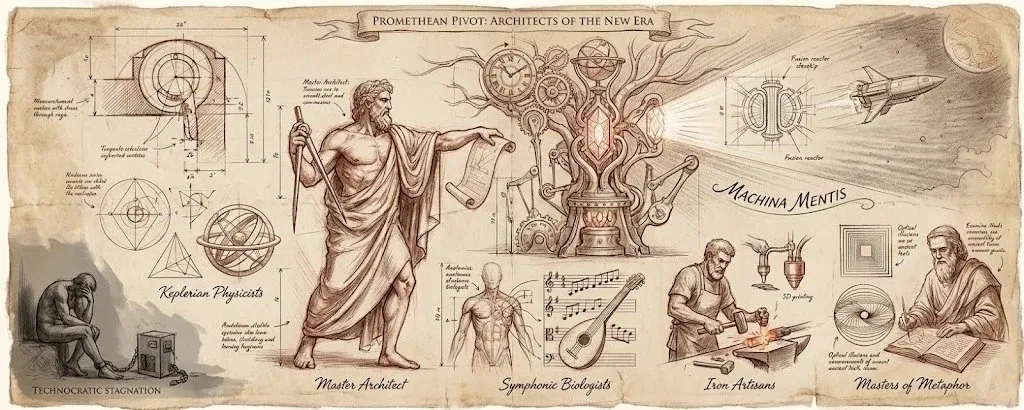
America stands at a fork in the road. Down one path lies a stagnant technocracy, where a pacified population survives on digital crumbs while algorithms manage a decaying status quo. Down the other lies a Promethean Pivot – a strategy to leverage AI not to replace human labor, but to amplify human genius.
To achieve this, we do not need UBI. We need a radical return to Classical Education, creating a workforce of “Master Architects” capable of commanding the new machines.
The Sextant and the Explorer
We must demystify the tool. Large Language Models and generative AI are engines of induction – essentially executing statistics at scale. They are brilliant at organizing known knowledge, detecting patterns in massive datasets, and optimizing existing systems. They are the ultimate sextant – calculating position and trajectory with superhuman speed. However, a sextant cannot decide where the ship should sail. That requires purpose (Teleology) and discovery (Hypothesis), only possible with the Human spirit.
The economic crisis we face is not a “Labor Surplus” caused by robots – it is a “Vision Deficit” caused by leaders who have accepted the end of history. If our economy remains a closed system of financial speculation and service jobs, then AI will indeed destroy it. But if we commit to a new era of Great Projects – commercializing nuclear fusion, colonizing the solar system, curing systemic disease, and creating works of art and buildings to rival the beauty of the Renaissance – we will find ourselves drastically understaffed.
We do not need fewer workers – we need workers with higher cognitive powers.
The New Division of Labor
For the last century, the American school system was designed on the Prussian industrial model, intended to produce standardized parts for a standardized economy. We trained students to memorize data and repeat processes. In the age of AI, that curriculum is a suicide pact.
To survive and thrive, we must invert the educational hierarchy. We must train students in the very skills the industrial age discarded: Metaphor, Irony, Geometry, and Polyphony.
Why? Because these cognitive frameworks allow the human mind to govern complex systems and generate discontinuous scientific leaps. We need to escape from Empiricism’s linear dead ends. In short, AI will free us to think through and imagine incalculable possibilities for discovery.
Here is what the new American workforce looks like when Classical Education meets Artificial Intelligence:
1. The Keplerian Physicist (Science & Physics)
In the quest for fusion energy, AI can run the calculus for plasma containment fields in milliseconds. But AI is trapped by its training data – it optimizes within the “box” of previous failures. We need physicists trained in Non-Euclidean Geometry and the harmonics of Johannes Kepler. Such a mind can visualize a topology that looks “wrong” to the algorithm but aligns with the deeper harmonic principles of the universe. The human provides the creative hypothesis while AI provides the computational proof.
2. The Symphonic Biologist (Medicine)
Modern medicine is often reductionist, treating the body as a chemical machine. AI reinforces this, scanning for single-molecule interventions. To cure systemic failures like cancer or Alzheimer’s, we need biologists educated in Classical Polyphony. A mind trained to hear the independent yet harmonized voices of a Bach fugue can intuitively grasp the complex, non-linear interactions of a metabolic system. They will use AI to model the “score” of the genome, conducting the technology toward a cure rather than a treatment.
3. The Iron Artisan (Tradecraft & Engineering)
The fear that manual trades will vanish is unfounded. While robots can mass-produce, they cannot innovate on the fly. The future belongs to the Artisan-Engineer – a tradesman educated in Sculpture and Materials Science. When a unique problem arises in our aging infrastructure, this artisan does not wait for a factory part. He diagnoses the issue with tactile intuition, uses generative AI to draft a solution, and 3D prints the component on-site. This is not the end of the blue-collar worker – it is the elevation of the worker to the status of a master craftsman.
4. The Master of Metaphor (Art & Defense)
In an era of deepfakes and algorithmic propaganda, the most critical national security asset is the ability to discern truth. A student educated in irony, poetry, and classical art understands that truth often lies in the subtext, not the pixel. These citizens will form the backbone of our diplomatic and intelligence services, using AI to sift through the noise but relying on human judgment to detect the intent behind the signal. They are the cognitive immune system of the Republic.
The Geopolitical Stakes
This is not just a domestic issue, it is the core of contemporary geopolitics. Authoritarian regimes are banking on the Technocratic Model to use AI to centrally plan their economies and monitor their populations, treating humans as cogs in a digital machine.
If America adopts UBI, we are implicitly accepting this model – agreeing that our citizens are liabilities to be managed rather than assets to be unleashed. We will stagnate, sliding into a dopamine-fueled decay while the world passes us by.
However, if we adopt a Promethean option, we leverage our unique cultural advantage: Liberty. A free mind, trained in the classical arts and armed with super-intelligent tools, can out-innovate any command economy.
The End of the “Reservation”
The proposal for Universal Basic Income is a surrender. It accepts the premise that the average American creates no value and must be paid to exist on a “digital reservation,” consumed by the Metaverse while the oligarchy manages the real world.
We must reject this hush money. The human spirit has no limit, and therefore, the economy – which is the physical expression of the human mind – has no limit.
The machines are here. The question is no longer “what can they do?” The question is “who will command them?”
If we stick to the industrial model of education, we will be their pets. If we embrace the Classical Renaissance, we will be their Architects. Let us choose the latter.
JAS