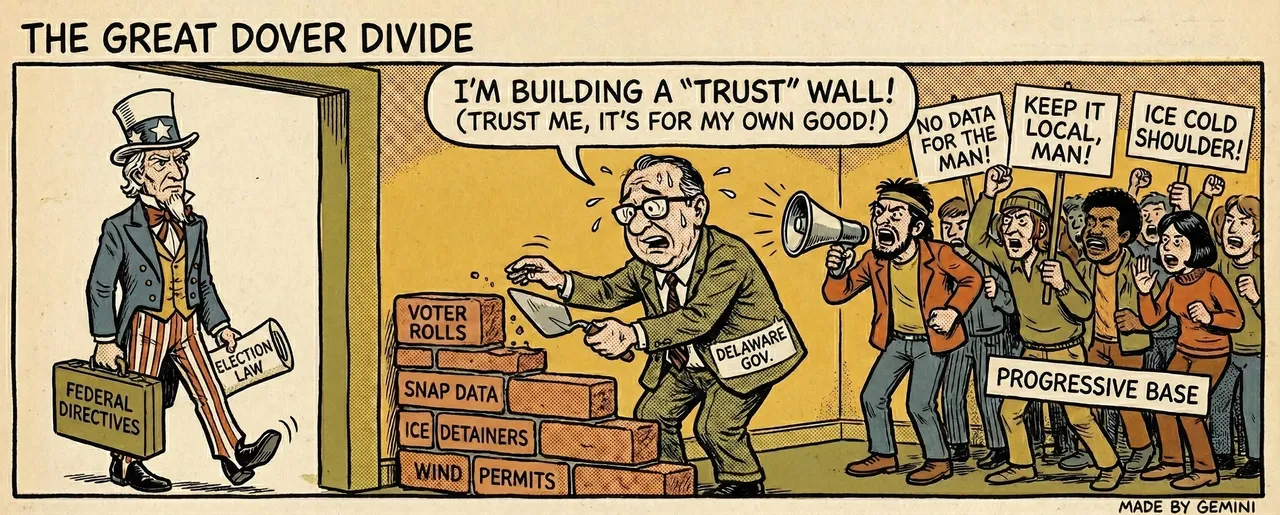
The Great Dover Divide
How Delaware’s Refusal to Comply with Washington Prioritizes Progressive Ideology Over Practical Governance
In the annals of American federalism, the “First State” has traditionally occupied a position of quiet pragmatism. Delaware, known for its corporate jurisprudence and moderate political temperament, rarely seeks the role of the political activist. Yet, six months into the new federal administration, Dover has emerged as the unlikely vanguard of a new, fierce brand of blue-state resistance. Under Governor Matt Meyer, the state has engaged in a systematic decoupling from federal directives – ranging from immigration enforcement to tax harmonization.(1)
While this intransigence is framed by state officials as a heroic defense of sovereignty and civil rights, a closer examination reveals a more parochial calculation. The Meyer administration is engaged in a precarious balancing act, rejecting federal requirements that often possess sound administrative logic – such as updating voter rolls or streamlining tax codes – to appease an increasingly vociferous progressive base. For Delaware’s Democratic leadership, the practical benefits of cooperation have been outweighed by the political necessity of staving off the ire of the activist left.
The Transparency Trap
Nowhere is this dynamic more visible than in the battle over data. Early in December, the U.S. Department of Justice requested unredacted voter registration data from all fifty states. The rationale was technocratic: the National Voter Registration Act mandates accurate rolls, and cross-referencing state data with federal identifiers is the most efficient mechanism to purge ineligible voters and ensure election integrity.
For a state bureaucracy, this is a standard hygiene measure. Yet, Delaware Election Commissioner Anthony Albence flatly refused, citing privacy statutes. The refusal was not merely a legal maneuver but a political signal. To the progressive activist class, any cooperation with the Justice Department’s “election integrity” initiatives is tantamount to voter suppression. By shielding the data, the state preserves its standing with civil liberties groups, even if it leaves the voter rolls less accurate and the state vulnerable to federal litigation.(2)
A similar logic governs the standoff with the Department of Agriculture (USDA) regarding SNAP benefits. When the USDA demanded data on recipients – including immigration status – to audit the program for fraud, Delaware joined a coalition of states in refusing. While the federal government argued that transparency is a fiscal prerequisite for taxpayer-funded programs, state leaders labeled the request “morally repugnant.” The practical imperative of fraud prevention was subordinated to the ideological imperative of non-cooperation with an administration viewed as hostile to the welfare state.
The Sanctuary Dilemma
The tension between practical governance and ideological purity is perhaps sharpest in the realm of public safety. With the passage of House Bill 182 in July 2025, Delaware codified a refusal to assist U.S. Immigration and Customs Enforcement (ICE), banning 287(g) agreements and the honoring of detainer requests without judicial warrants.
From a law enforcement perspective, the federal request for cooperation is a force multiplier; it allows local and federal agencies to seamlessly transfer custody of criminal offenders who lack legal status. However, to the Democratic base, the “sanctuary” designation is non-negotiable. By severing ties with ICE, Delaware officials insulate themselves from accusations of complicity in the administration’s deportation agenda. The cost of this political insulation is the potential release of offenders back into the community – a risk the state is willing to take to maintain its progressive bona fides.
The Economics of Resistance
The resistance has also bled into economic policy, where the state has chosen to penalize its own business environment rather than align with Washington’s “One Big Beautiful Bill Act” (OBBBA). The federal legislation, passed in July, offered 100 percent bonus depreciation and immediate R&D expensing – classic pro-growth levers designed to spur investment.
Rather than accepting these incentives to modernize the local economy, Delaware “decoupled” its tax code via House Bill 255.3 Governor Meyer framed this as a measure of fiscal survival to protect education funding. However, the move also served a dual purpose: it rejected the economic philosophy of the federal administration. By refusing to import federal tax cuts, Delaware signaled its allegiance to a high-tax, high-service model favored by public sector unions, even as business groups warned that the divergence would render the state uncompetitive for capital investment.(3)
Similarly, in the energy sector, Delaware’s lawsuit to overturn the federal freeze on offshore wind permitting was celebrated by environmentalists as a victory for the planet. Yet, the federal moratorium was arguably a prudent pause to reassess the hasty approval processes of the previous era and address the economic concerns of coastal communities. By rushing to the courts, Delaware prioritized the optics of “green energy” advocacy over a deliberative review of the industry’s local impact.
The Cultural Firewall
Finally, the state has erected a “shield” around the most contentious issues of the culture war: gender identity and housing. Governor Meyer’s Executive Order #11, which blocks cooperation with out-of-state or federal investigations into gender-affirming care, is a direct response to the base’s demand for a firewall against conservative social policy. Likewise, the state’s rejection of HUD’s conditions – which sought to attach sobriety and biological gender requirements to housing grants – demonstrates a willingness to risk millions in federal funding to defend the “Housing First” orthodoxy.(4)
While the federal administration’s push for “accountability” in housing grants argues that unconditional aid has failed to reduce homelessness, Delaware’s leadership cannot entertain such a concession. To accept HUD’s terms would be to admit that the progressive approach to homelessness requires reform – an admission that is politically impossible in the current climate.
Conclusion
As 2025 draws to a close, Delaware stands as a fortress of non-compliance. To the casual observer, this appears to be a fight for states’ rights. But in reality, it is a fight for political survival within the Democratic Party.
Governor Meyer and his administration have calculated that the wrath of the federal government is manageable, while the wrath of their own voters is not. They have chosen to reject federal requirements that – whether in cleaning voter rolls, auditing welfare, or incentivizing business – make sound practical sense. In doing so, they have secured their flank against the left, but they have also deepened the fracture of the American union, sacrificing administrative coherence on the altar of ideological purity.
JAS