
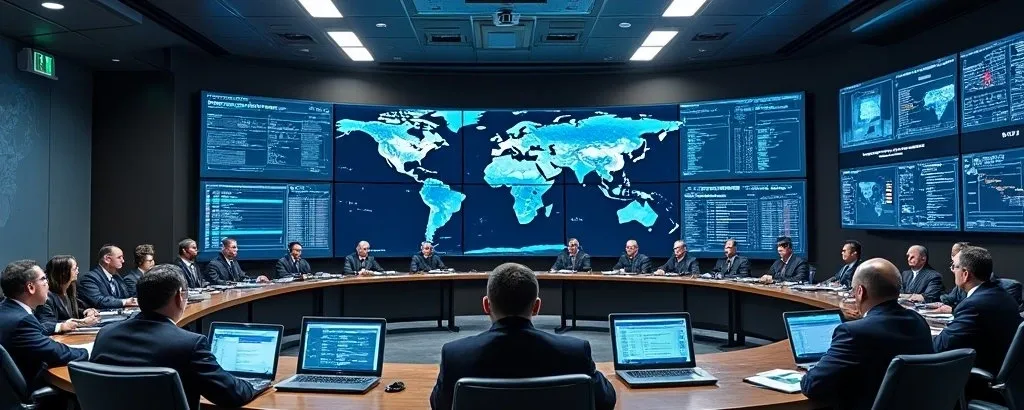
The Joint Force Operating System (JFOS)
A New Era of Warfare Demands a Transformed Department of Defense (DoD)
DoD stands at a critical inflection point. The 21st century has ushered in a new era of warfare, one fundamentally different from the conflicts of the past. Exponential advances in artificial intelligence (AI), machine learning, and hyperscale cloud computing are rapidly reshaping the character of war, demanding unprecedented speed, agility, and data integration from our military forces. The ongoing conflict in Ukraine provides a stark illustration of this new reality. Modern warfare is characterized by near-total battlefield transparency, rapid maneuver, and relentless multi-domain competition. Legacy systems and hierarchical decision-making structures, designed for a bygone era, have become significant liabilities in this environment. Furthermore, peer competitors are rapidly modernizing their forces, leveraging these same emerging technologies to close the gap with the United States.[1] This creates a strategic environment where inaction by the DoD equates to strategic decline. To maintain its strategic advantage and ensure national security, the United States military must embrace a radical new approach to its organization, operations, and technological infrastructure.
The core challenge is to move beyond the limitations of a rigid, hierarchical structure designed for a slower, less technologically complex era. The Joint Force needs to become a more agile, adaptable, and data-driven organization, capable of learning and evolving faster than its adversaries. This requires a fundamental shift in how information is managed and utilized. Instead of being trapped in isolated systems, data must flow freely and securely across the entire organization, accessible to those who need it, when they need it. It also demands a new level of collaboration between humans and intelligent machines. AI must be integrated into the very fabric of the military, augmenting human capabilities and enabling faster, better-informed decisions at all levels, from the battlefield to the highest levels of command.
This transformation necessitates a new kind of operating system for the Department of Defense – a system that can connect every sensor, every unit, and every decision-maker in a seamless, intelligent network. This system must be able to ingest and analyze vast quantities of data in real-time, identify patterns and anomalies, and provide actionable insights to human operators. It must be secure, resilient, and adaptable, capable of evolving alongside emerging technologies and incorporating lessons learned from the field. By building such a system, the U.S. military can achieve a level of operational effectiveness far beyond its current capabilities. Enabling it to anticipate threats, optimize resources, and act decisively in any situation. This is not simply about keeping pace with our adversaries; it is about fundamentally outpacing them through superior decision-making and operational agility. The first to master this new paradigm of warfare will gain an enduring advantage. The cost of inaction is not merely falling behind; it is the potential loss of the ability to deter and, if necessary, win wars.
Embracing the Computational Domain-Organized Architecture (CDOA)
To meet the strategic crisis posed by the rapidly evolving character of warfare, the DoD must undergo a fundamental transformation, embracing a new organizational paradigm: Computational Domain-Organized Architecture (CDOA). This concept, deeply rooted in the principles of domain-driven design, AI-Agents, network centric warfare, and organizational science, particularly Computational Organization Theory (COT) pioneered by Dr. Kathleen M. Carley. [2][3] This represents a radical departure from the rigid, hierarchical structures that have long characterized the U.S. military.
CDOA restructures the DoD into a network of autonomous, domain-based units, each responsible for its own data, decision-making, and mission execution. Imagine, specialized domains for logistics, intelligence, cyber operations, and various combat arms, each operating with a high degree of autonomy. These domains are not isolated silos but rather interconnected nodes within a larger network, able to share data and coordinate actions seamlessly. Critically, this structure is enabled by a fundamental shift in how humans interact with data and systems. Within each domain, human operators work in close collaboration with AI agents, forming tightly integrated human-machine teams. These AI agents are not simply tools in the traditional sense; they represent a paradigm shift from reliance on Software-as-a-Service (SaaS) models[4]. Instead of humans using SaaS as an interface and analytical tool to ‘see’ and manipulate data, AI agents within CDOA will act as intelligent intermediaries, directly accessing, analyzing, and interpreting data from the data mesh. This frees human operators from the drudgery of manual data analysis, allowing them to focus on higher-level tasks that require creativity, judgment, and strategic thinking. This decentralized structure enables faster, more informed decision-making. CDOA is not about replacing human judgment with automation but to create a framework for optimal human-machine teaming, where the strengths of both are leveraged to achieve superior outcomes.
This transition from human-driven SaaS interaction to AI-agent-mediated data analysis is a foundational element of CDOA. It allows for a level of speed, efficiency, and insight that is simply unattainable with previous models. AI agents can process and analyze vast quantities of data in near real-time, identifying patterns and anomalies that would be missed by human analysts. They can then present this information to human operators in a clear, concise, and actionable format, providing the necessary context for informed decision-making. CDOA places human operators at the center of the decision-making process. This human-centric approach ensures that DoD remains not only a technologically advanced fighting force but also one that is ethically grounded and aligned with American values. By embracing the principles of decentralization, autonomy, specialization, and human-machine collaboration, the DoD can unlock the full potential of its personnel and resources, ensuring that it remains prepared to meet the challenges of an increasingly complex and competitive security environment.
The Joint Force Operating System (JFOS): The Engine for Transformation
JFOS is the critical technological enabler for realizing the transformative potential of CDOA. It provides the necessary digital backbone for a decentralized, data-driven, and AI-enhanced DoD. More than just a software system, JFOS represents a seismic shift in how DoD operates, transforming it into a seamlessly integrated human-machine ecosystem. Underpinned by CDOA principles, JFOS effectively transforms the Pentagon into a human-machine processor capable of operating at machine speed.
At the heart of JFOS lies the data mesh, a concept pioneered by Zhamak Dehghani.[5] This decentralized data architecture connects all domains within DoD, enabling seamless data sharing and access while maintaining domain autonomy. Each domain produces and maintains its own data products, adhering to strict quality standards and discoverability requirements. This ensures that data is treated as a product, readily available to those who need it, when they need it. Data mesh eliminates data silos that have long plagued large organizations, fostering a culture of data sharing and collaboration. It forms the foundation for a truly data-driven DoD.
To ensure interoperability and understanding across this vast and diverse data landscape or better said as to better “see ourselves”, JFOS employs semantic services, creating a “common language” for the entire DoD. These services leverage Unique Identifiers (UIDs), eXtensible Bill of Materials (xBOMs), and Controlled Canonical Vocabulary (CCV). UIDs provide a unique digital fingerprint for every entity within the DoD – from personnel and equipment to locations and concepts. xBOMs define the composition and relationships of complex systems, enabling automated analysis of dependencies and vulnerabilities. The CCV establishes a standardized set of terms and definitions, ensuring that information is interpreted consistently across all domains and applications.
JFOS leverages the Compound AI concept, influenced by Dr. Potts’ work, where multiple AI agents, each specialized in a particular domain or task, work together in a coordinated fashion. [6] This is analogous to a network of human experts collaborating on a complex problem. These AI agents, trained and maintained in-house, are not limited to processing structured data; they also analyze unstructured data, such as text, images, and video, extracting valuable insights and providing recommendations to human operators. This collaborative network of AI agents, guided by semantic understanding, forms the core intelligence of JFOS.
However, as AI capabilities rapidly advance, JFOS must be prepared for the potential emergence of malicious artificial intelligence, ranging from sophisticated adversarial AI agents to advanced AGI and even ASI. To counter this threat, JFOS incorporates a security layer inspired by the decentralized, immutable nature of the Bitcoin network and drawing upon ideas presented in Major Jason Lowery’s “Softwar”.[7] The Bitcoin blockchain’s proof-of-work mechanism serves as a “digital fortress,” imposing a significant computational cost on any attempt to manipulate or corrupt key data nodes within the JFOS ecosystem. Any adversarial AI attempting to infiltrate or subvert these nodes would need to overcome Bitcoin’s computational barrier, effectively making such an attack prohibitively expensive and impractical. This acts as a powerful deterrent, ensuring the integrity and trustworthiness of the JFOS environment.
Furthermore, this proof-of-work mechanism plays a crucial role in maintaining control and defense of DoD’s own AI agents. Each agent, operating within its respective domain, is cryptographically linked to this secure framework. Any deviation from authorized behavior or any attempt to access data outside its designated domain would require overcoming the computational barrier, triggering alerts and initiating countermeasures. This ensures that DoD’s AI agents remain aligned with their intended purpose and under human oversight, preventing them from being hijacked or manipulated by external or internal threats. This “digital immune system” safeguards the integrity of each domain and the entire CDOA framework.
JFOS is not just a technological upgrade but a fundamental shift in how DoD operates. It creates a seamless, intelligent ecosystem were humans and AI work together, leveraging the strengths of both. JFOS enables DoD to operate at machine speed, making decisions faster and more effectively than ever before, ultimately giving it a decisive advantage in any conflict. JFOS is the key to unlocking the operational agility and technological superiority needed to prevail in the wars of the future.
A Revolution in Military Affairs: JFOS and the Transformation of Warfare
The implementation of JFOS represents not merely an incremental improvement in military operations but a profound revolution in military affairs (RMA), fundamentally altering the character of warfare and demanding a reassessment of long-held military theories. At its core, JFOS empowers DoD to operate with machine-like speed and precision, seamlessly weaving together human judgment and AI-driven intelligence, transforming the force into a dynamic, learning ecosystem that can anticipate and respond to threats with unprecedented agility. This is not simply about doing the same things faster; it’s about doing them differently and achieving qualitatively new levels of military effectiveness.
JFOS, by enabling near real-time situational awareness, planning, and resource management across every echelon of DoD, directly addresses the “fog of war” that Clausewitz famously described as a defining characteristic of conflict.[8] By providing a comprehensive, data-driven picture of the battlespace, JFOS reduces uncertainty and allows for more informed decision-making at all levels, from strategic to tactical. Decentralized decision-making, supported by AI-driven insights and authoritative data products, empowers units to act quickly and decisively, exploiting fleeting opportunities and adapting to rapidly changing circumstances. JFOS’ agility allows the U.S. military to operate inside the enemy’s decision cycle, a concept that echoes Sun Tzu’s emphasis on speed and preemption as keys to victory.[9] However, the speed enabled by JFOS does not eliminate the need for strategic patience, as Thucydides would advise.[10] JFOS provides the ability to choose the right moment to act, increasing the probability of success.
The system’s modularity, scalability, and continuous upgradability ensure that DoD can rapidly integrate new technologies and adapt to evolving threats, a crucial capability in an era of rapid technological change. This adaptability is not limited to technology alone; it extends to organizational structure, doctrine, and even military strategy. JFOS will fundamentally change how DoD fights, plans, and thinks about war. It will necessitate a reassessment of traditional military concepts such as mass, maneuver, and concentration of force. Clausewitz’s notion of the “culminating point of the offensive,” for example, may need to be reinterpreted considering the ability of JFOS-enabled forces to sustain operations with greater efficiency and resilience, potentially overcoming logistical and geographical limitations. Similarly, the concept of “centers of gravity” may need to be redefined in an era where distributed networks and AI-powered systems can create multiple, shifting centers of power. JFOS provides the ability to both identify and neutralize an adversary’s center of gravity more quickly and effectively.
This revolution in military affairs is not just about keeping pace with adversaries; it’s about fundamentally outpacing them, ensuring the U.S. remains the dominant military power for decades to come. It is about creating a military force that is not only technologically superior but also conceptually and doctrinally advanced, capable of adapting to any challenge and prevailing in any conflict. JFOS provides the ability to learn the lessons identified by Thucydides and Clausewitz and apply them faster than any adversary. A JFOS-enabled force will be able to learn and adapt faster than any adversary, constantly refining its strategies, tactics, and technologies based on real-time feedback from the battlefield. This continuous learning and adaptation, a defining characteristic of the JFOS ecosystem, will be the key to maintaining American military preeminence in the 21st century and beyond. It is a revolution that will reshape not only how wars are fought but also the very nature of military power in the information age.
Securing Strategic Dominance in a Contested World: The Imperative of a 4th Offset Strategy
The strategic outcomes of implementing JFOS are profound and far-reaching, promising to ensure the United States maintains its military dominance in an era of great power competition. However, the current strategic environment is not static. Peer competitors are investing heavily in AI and related technologies, seeking to close the gap with, and even surpass, the U.S. This creates a strategic imperative, a need for a “4th Offset Strategy”, to maintain American military preeminence.[11] There is a clear first-mover advantage in fully integrating AI into military operations, and JFOS is the key to achieving that advantage. By enabling DoD to adapt, innovate, and learn at an unprecedented pace, JFOS provides the strategic and operational edge needed to deter adversaries, prevail in any conflict, and secure American interests in a rapidly changing world.
The urgency of this situation cannot be overstated. The war in Ukraine provides a glimpse into the future of warfare, highlighting the importance of battlefield transparency, rapid adaptation, and multi-domain integration – capabilities that JFOS directly enables. We are witnessing a fundamental shift in the character of war, driven by the rapid advancement and proliferation of AI-enabled technologies. Drones, autonomous systems, cyber warfare, and information operations are becoming increasingly sophisticated and decisive. To merely keep pace with these developments is insufficient; the United States must proactively shape the future of warfare by fully embracing the transformative potential of AI.
JFOS is not just a technological solution; it is the cornerstone of a new 4th Offset Strategy. A strategic initiative designed to ensure enduring American military dominance. The previous offset strategies relied on nuclear deterrence (1st Offset), precision-guided munitions (2nd Offset), and stealth and sensor fusion (3rd Offset) to maintain a decisive advantage. Now, in the 21st century, the 4th Offset will be defined by the mastery of artificial intelligence and its seamless integration into all aspects of military operations. JFOS, by creating a unified, AI-enhanced ecosystem, provides the foundation for this new offset strategy, enabling DoD to achieve superiority, operational agility, and technological overmatch against any adversary. The elegance of JFOS enables the application of many different forms of AI, from many different sources, to be applied against many different problem sets.
Moreover, JFOS allows for the evolution of Brigade Combat Teams into smaller, more modular, and rapidly adaptable formations with organic capabilities for counter-UAS, electronic warfare (EW), and integrated intelligence, surveillance, and reconnaissance (ISR). The system’s ability to seamlessly integrate sensors, shooters, and decision-makers – across all domains – provides a decisive advantage in identifying, targeting, and defeating threats in near-real time. This is not merely an incremental improvement; it is a qualitative leap forward in military capability, enabling the U.S. to fight and win in a fundamentally different way.
Furthermore, JFOS fosters a culture of continuous learning and innovation, ensuring that DoD can rapidly adapt to emerging technologies and evolving threats. AI agents within JFOS are constantly learning and improving, providing an ever-increasing advantage over adversaries who rely on more static systems and doctrines. This creates a virtuous cycle of innovation, where new technologies are rapidly integrated, tested, and deployed, further enhancing DoD’s capabilities. The ability to adapt and evolve at machine speed will be the defining characteristic of military success in the 21st century. The race for technological advantage is more dynamic than ever before.
Unlocking Efficiency and Investing in the Future: A Paradigm Shift in Resource Allocation
Implementing JFOS will generate significant personnel and financial efficiencies, freeing up resources for modernization and high-priority missions. This is not merely about incremental cost savings; it represents a paradigm shift in how DoD allocates its resources. Enabling a strategic reinvestment in the capabilities that will define future military dominance. By automating routine tasks, streamlining processes, and optimizing resource allocation, JFOS provides dramatically reduce administrative overhead, a reallocate personnel to higher-value activities, and significant cost savings that can be channeled directly into force modernization.
One of the most significant areas of efficiency gains will be personnel. JFOS, through its AI-powered automation capabilities, can substantially reduce headquarters’ staff currently dedicated to administrative tasks. This includes automating tasks such as report generation, data entry, scheduling, and other routine processes that currently consume a significant portion of staff time. This reduction in administrative overhead will allow DoD to reallocate thousands of personnel to more critical operational and strategic roles. These individuals, freed from mundane tasks, can be retrained and redeployed to areas such as cyber warfare, intelligence analysis, AI development, and other high-priority fields. This represents a significant human capital dividend, allowing the DoD to cultivate a more skilled, agile, and adaptable workforce.
The transition to domain-based autonomy and data-driven governance, facilitated by JFOS, also generates substantial efficiencies. By empowering domains to manage their own data and resources, JFOS eliminates redundancies, streamlines supply chains, and automates costly legacy processes. For example, the JFOS data mesh, with its standardized data products and semantic services, will enable automated inventory management, predictive maintenance, and optimized logistics across DoD. This will result in significant cost savings in areas such as procurement, warehousing, and transportation. The current quagmire of incompatible systems and manual data reconciliation will be replaced by a seamless, automated, and data-driven resource management system.
Furthermore, the modularity and scalability of the JFOS data mesh architecture reduces long-term maintenance costs and facilitates technology upgrades. Unlike monolithic legacy systems that are costly to maintain and upgrade, JFOS is designed to be adaptable and future-proof. Importantly, the open architecture and use of open standards within JFOS are specifically designed to avoid vendor lock-in. DoD will not be tied to a single vendor’s proprietary technology, allowing for greater flexibility, competition, and innovation. New technologies and capabilities, sourced from a diverse ecosystem of providers, can be easily integrated into the system without requiring a complete overhaul. This agility will allow DoD to keep pace with the rapid advancements in AI, machine learning, and other emerging technologies, ensuring that it maintains a technological edge over its adversaries. This also allows DoD to leverage innovation from the private sector, while maintaining control over its own data and systems.
Importantly, JFOS enhances transparency and accountability in resource management, making DoD more audit-ready and improving fiscal responsibility. Every transaction, every decision, every data point within JFOS is tracked, logged, and auditable. This creates an unprecedented level of transparency, allowing for more effective oversight and management of resources. This enhanced accountability will not only improve DoD’s internal processes but also strengthen public trust in the Department’s stewardship of taxpayer dollars. The current byzantine and error-prone financial management systems will be replaced by precision and clarity.
The efficiencies gained through JFOS are not just about cost savings; they are about strategically reallocating resources to where they are needed most: modernization, innovation, and the development of critical capabilities. The cost savings generated by JFOS will free up billions of dollars that can be reinvested in areas such as hypersonic weapons, directed energy, artificial intelligence, and space-based assets. This will enable the DoD to accelerate the development and fielding of next-generation technologies, ensuring that the U.S. maintains its military preeminence. This is how the world’s most advanced military can also be one of the most efficiently run, setting a new standard for fiscal responsibility and operational effectiveness.
The AI Training & Alignment Cell (AITAC): Ensuring Ethical, Responsible, and Field-Informed AI
Realizing JFOS requires a dedicated, in-house AI training and alignment capability to ensure the secure, ethical, and operationally relevant development of AI agents. This oversight is provided by an AI Training & Alignment Cell (AITAC), staffed by qualified military personnel within existing government research facilities. This is crucial for developing, training, and maintaining AI agents that are both effective and aligned with DoD doctrine, ethical principles, and most importantly, the realities of the battlefield. AITAC will serve as the crucial link between cutting-edge AI research and the practical experience of warfighters, creating a virtuous cycle of knowledge transfer that benefits both the AI systems and the humans who will ultimately rely on them.
AITAC will leverage the expertise of senior officers and academics (“greybeards”) from the Services’ war colleges with decades of experience in planning and executing military operations. These seasoned warfighters will provide iterative human feedback and specialized training modules to AI agents, ensuring that they are not just technically proficient but also grounded in the nuances of military doctrine, strategy, and tactics. This is not simply about theoretical knowledge; it’s about transferring the hard-won lessons learned from countless real-world operations, often at great cost. AITAC will capture these lessons, codified through countless After Action Reviews (AARs), and translate them into a format that can be understood and applied by AI agents. This process ensures that AI agents within JFOS are informed by the collective wisdom of generations of warfighters.
Furthermore, AITAC will establish a continuous feedback loop between the field and the development process. Data and insights gathered from JFOS operations, including successes, failures, and near misses, is fed back into AITAC, informing the training and refinement of AI agents. This creates a dynamic system where AI agents are constantly learning and adapting based on real-world experience, much like a seasoned military officer. This also provides a mechanism to rapidly incorporate lessons learned into JFOS, ensuring that the system remains relevant and effective in a constantly evolving operational environment. This process provides an accelerated version of Boyd’s OODA (Observe-Orient-Decide-Act) loop which enables a faster, more refined, decision-making process.[12]
All operations, from data collection to model deployment, will be conducted in-house, ensuring the confidentiality of sensitive data and preventing unauthorized access. Robust governance structures, including ethics boards and technical oversight committees, will uphold the laws of armed conflict, ensure alignment with American values, and mitigate risks. These boards will be composed of not only technical experts but also ethicists, legal scholars, and senior military leaders to ensure a holistic approach to AI governance.
AITAC will also cultivate a pipeline of new AI-literate officers and analysts through ongoing coursework, seminars, and wargaming-style simulations. These junior personnel will benefit directly from the knowledge and experience of the “greybeards,” creating a new generation of warfighters who are fluent in both the art of war and the language of artificial intelligence. They, in turn, will contribute to the ongoing development and refinement of JFOS, ensuring its continued effectiveness in the future. This continuous cycle of learning and adaptation, from “greybeards” to AI agents to the next generation of warfighters, is the essence of AITAC’s mission.
AITAC is essential for ensuring that the AI agents within JFOS are not only technically proficient but also ethically sound, aligned with American values, and deeply informed by the realities of military operations. By keeping AI development in-house and under the strict control of military personnel, the DoD can mitigate the risks associated with commercial AI development while ensuring that its AI capabilities are tailored to its specific needs and operational requirements.
The Parallel Pentagon: A Crucible for Safe and Responsible JFOS Development
To realize the transformative potential of JFOS while mitigating the inherent risks of such revolutionary technology, there must be the establishment of an off-site, fully functional “Parallel Pentagon” environment. This controlled setting will serve as a crucible for safe experimentation, rigorous testing, and iterative refinement of CDOA-based architecture, AI-driven decision-making, and decentralized governance models before any operational deployment. The Parallel Pentagon provides a secure, isolated environment where we can push the boundaries of JFOS development without jeopardizing current operations or national security. This allows us to identify and address potential technical challenges, ethical dilemmas, and unforeseen consequences in a controlled setting. This environment will facilitate a rapid, iterative development process, allowing engineers, operators, and warfighters to work together to refine JFOS’s architecture, algorithms, and human-machine interfaces. This collaborative approach ensures that the system is not only technically sound but also operationally effective and aligned with human values.
Some may raise concerns about the cost of establishing and maintaining a “second Pentagon.” However, this perspective fails to account for the immense long-term cost savings and risk mitigation benefits that the Parallel Pentagon provides. By allowing us to identify and address critical issues early in the development process, the Parallel Pentagon will prevent costly mistakes and rework down the line. It enables us to “fail fast” in a safe environment, learning valuable lessons and iterating on the design before deploying JFOS to operational units. This approach is far more cost-effective than attempting to fix problems after they have emerged in a live operational setting, where the consequences of failure can be severe. Furthermore, the Parallel Pentagon will accelerate the development and fielding of JFOS, delivering its transformative capabilities to the warfighter sooner. This accelerated timeline translates into a strategic advantage, allowing the U.S. to maintain its military preeminence in a rapidly evolving security environment.
The Parallel Pentagon will also serve as a crucial proving ground for the cultural shift required to embrace a decentralized, AI-enhanced command structure. By allowing personnel to train and operate within this new paradigm in a safe environment, we can foster understanding, build trust, and reduce resistance to change. AITAC will be fully integrated into the Parallel Pentagon, providing direct oversight of AI development and ensuring that all AI agents are rigorously trained, tested, and aligned with DoD doctrine, ethical guidelines, and legal requirements. The “greybeard” mentorship program within AITAC will be crucial in providing real-world context and experience to guide the development process. The Parallel Pentagon will be overseen by a council of former senior military leaders and leading technologists. This independent body will provide objective assessments of JFOS’s development, ensuring that it remains aligned with strategic goals and ethical principles. Their guidance will be invaluable in navigating the complex challenges of this transformative initiative.
The Parallel Pentagon is a strategic investment that will ultimately save resources while accelerating delivery of a critical capability. It is a prudent and necessary step to ensure that JFOS is developed responsibly, effectively, and ethically. The upfront investment in the Parallel Pentagon pales in comparison to the potential costs of deploying a flawed system or falling behind adversaries in the race to integrate AI into military operations. It is a tangible demonstration of our commitment to fielding a transformative capability while mitigating risks and maximizing the return on investment for the American people.
Embracing the Future of Warfare: A Call for Bold Action
JFOS represents a revolutionary path forward for the Department, a strategic imperative in an era defined by rapid technological change and great power competition. This path presented a bold vision for a transformed DoD, underpinned by CDOA and enabled by the cutting-edge technologies. This is not merely a proposal for technological upgrades; it is a blueprint for a fundamental transformation in mindset, culture, and operational doctrine, a reimagining of how the U.S. military will fight and win in the 21st century and beyond.
The transition to JFOS, while undoubtedly challenging, is essential if the U.S. is to maintain its strategic military advantage. The potential hurdles of cultural resistance, technical integration complexities, and the cultivation of new skill sets are real but surmountable. Through strong leadership, clear communication, robust governance structures, and the innovative “Parallel Pentagon” approach to development and testing, these challenges can be effectively mitigated. The long-term benefits of JFOS – enhanced agility, adaptability, decision-making speed, and optimized resource allocation, all leading to an increase in operational tempo through an enhanced OODA Loop – far outweigh the risks of inaction. The true risk lies in clinging to outdated structures and processes while adversaries embrace the transformative potential of AI and related technologies.
JFOS, with its decentralized data mesh, semantic services, and network of collaborative AI agents, is more than just a system; it is an ecosystem, a dynamic and adaptive architecture that mirrors the complexity of the modern battlespace. It is a platform for continuous learning and innovation, enabling DoD to not just react to threats but to anticipate and shape them. AITAC ensures that this powerful system is developed ethically, responsibly, and in a manner deeply informed by the experience of seasoned warfighters. The “Parallel Pentagon” provides the crucial proving ground for this transformative technology, allowing for rigorous testing and refinement in a safe and controlled environment.
The adoption of JFOS is not just about maintaining pace with adversaries; it is about seizing the first-mover advantage in the integration of AI into military operations. It is about securing the foundation for a 4th Offset Strategy, ensuring American military dominance for decades to come. This is an opportunity to fundamentally reshape the character of warfare, to redefine the limits of military power, and to secure a future where the United States remains the architect of its own destiny.
The time for incremental change has passed. The challenges and opportunities presented by the 21st-century security environment demand bold action. We must embrace the transformative potential of JFOS and embark on this journey of change with courage, foresight, and a clear understanding of the stakes involved. Let us choose not to be merely the inheritors of a proud military legacy but the pioneers of a new era of military power, an era defined by human-machine collaboration, data-driven decision-making, and an unwavering commitment to securing a peaceful and prosperous future. The future of warfare is not something to be passively observed; it is something to be actively shaped. With JFOS, the DoD can seize this opportunity and build a force that is not just ready for the future but is, in fact, the architect of that future.
JAS
References:
[1] Putin, Vladimir. “Artificial Intelligence and Its Role in Modern Society.”Remarks delivered at an open lesson with students, 1 September 2017. Kremlin.ru, https://en.kremlin.ru: “Artificial intelligence is the future not only of Russia but of all of mankind…Whoever becomes the leader in this sphere will become the ruler of the world.”
[2]Carley, Kathleen, M and Prietula, Michael J, Computational Organizational Theory, March 2014, Carnegie Mellon University, pg. xiii “agents in organizational models tend to act in parallel and to adapt to the behavior of other agents.”
[3] Alberts and Hayes, Power to the Edge: Command Control in the Information Age, Command and Control Research Program (CCRP), DoD, 2003
[4] Microsoft CEO Satya Nadella on podcast with BG2 w/ Bill Gurley & Brad Gerstner, 12 December 2024, at minute 46:45, AI Agents to replace SaaS, https://www.youtube.com/watch?v=9NtsnzRFJ_o
[5] Dehghani, Zhamak. Data Mesh: Delivering Data-Driven Value at Scale. Sebastopol, CA: O’Reilly Media, 2022.
[6] Stanford Online. “Stanford Webinar – Large Language Models Get the Hype, but Compound Systems Are the Future of AI.” YouTube video, 58:06. December 3, 2024. http://www.youtube.com/watch?v=vRTcE19M-KE.
[7] Lowery, Jason P. “Softwar: A Novel Theory on Power Projection and the National Strategic Significance of Bitcoin.” Master’s thesis, Massachusetts Institute of Technology, 2023. MIT DSpace. https://dspace.mit.edu/handle/1721.1/153030.
[8] Clausewitz, Carl von. On War. Edited and translated by Michael Howard and Peter Paret. Princeton, NJ: Princeton University Press, 1989.
[9] Sun Tzu. The Art of War. Translated by Samuel B. Griffith. Oxford: Oxford University Press, 1971.
[10] Thucydides. History of the Peloponnesian War. Translated by Rex Warner. Revised ed. London: Penguin Classics, 1972.
[11] Wittman, Rob. “Wittman: Why Manned-Unmanned Teaming Could Be the Fourth Offset for America’s Military.” U.S. House of Representatives. May 30, 2023. https://wittman.house.gov/news/documentsingle.aspx?DocumentID=5034
[12] Boyd, John R. A Discourse on Winning and Losing. Edited by Grant T. Hammond. Maxwell Air Force Base, AL: Air University Press, 2018. https://www.coljohnboyd.com/static/documents/2018-03__Boyd_John_R__edited_Hammond_Grant_T__A_Discourse_on_Winning_and_Losing.pdf