The Zero-Marginal-Cost Election
The AI revolution will not just boost economic efficiency – it will industrialize political persuasion.
In the boardrooms of New York and London, executives have settled on a comforting narrative regarding artificial intelligence. They tell a story of productivity and margin expansion. Banks, logistics firms, and retailers now deploy large language models to slash overhead, streamline supply chains, and automate customer service. Wall Street treats this as the long productivity trade – a benign evolution of capital efficiency.
But this economic optimism blinds investors to a darker, more volatile transformation. A revolution is sweeping through a sector that operates with zero regulation and existential stakes – the political campaign. While corporations utilize AI to cut the cost of doing business, political operatives now wield it to collapse the cost of acquiring power.
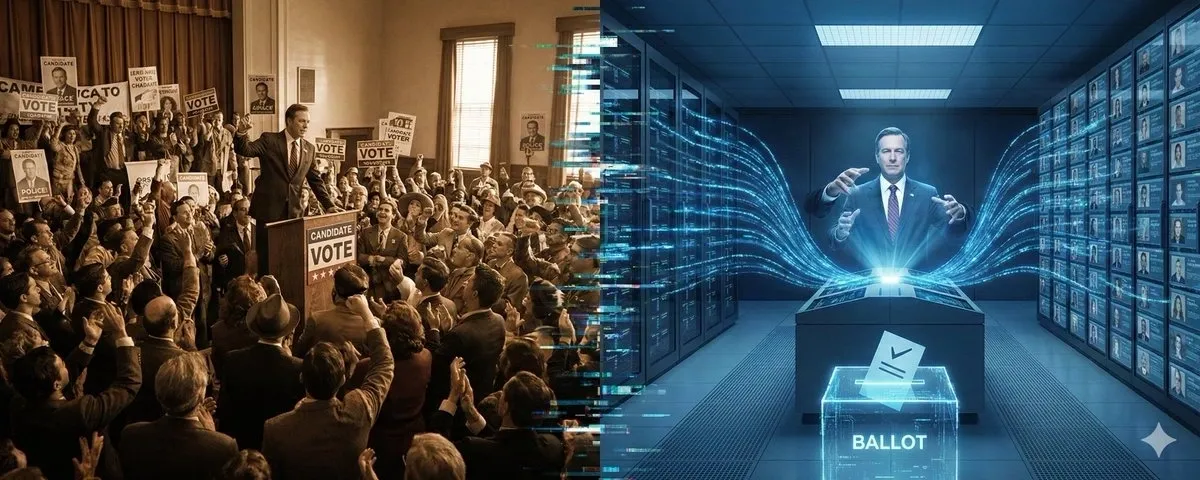
The upcoming electoral cycles in the West will dismantle the traditional campaign industrial complex. We are abandoning the era of broadcast democracy – where candidates pay to speak to millions – and entering the age of precision-targeted algorithmic warfare. In this new reality, the “cost per vote” plummets to near zero, and millions of custom-made, synthetic realities replace the public square.
The Obliteration of Demographics
For decades, political strategists hunted the demographic block. They targeted suburban women, union households, or evangelical voters. Campaigns accepted this crude necessity because they lacked data and faced high distribution costs.
AI destroys this approach. The “market of one” now rules political strategy. By synthesizing voter files with commercial data and behavioral histories, AI models build unique psychological profiles for individual citizens. The 2026 and 2028 cycles will not air generic television spots. Instead, algorithms will fire millions of distinct messages, each targeting a specific voter’s neurochemical triggers.
As economists celebrate this efficiency, political operatives will weaponize its intimacy. The AI system no longer guesses which policy appeals to a voter. It tests thousands of variations by adjusting tone, imagery, and semantic structure until it strikes the precise combination that forces engagement.
The Infinite Canvasser
Labor constraints have always throttled democratic politics. Volunteers tire. Staffers burn out. Human persuasion works, but it costs too much and scales too slowly.
AI removes this constraint. Enter the infinite canvasser, voice-enabled AI agents that hold millions of simultaneous, unique, and interactive conversations. These agents do not play robotic pre-recorded messages. They debate policy. They feign empathy. They pivot based on a voter’s emotional state. They speak in any language or dialect.
This dissolves the barrier to entry for political messaging. When a campaign commands a legion of tireless, unpaid, and perfectly disciplined persuaders, the ground game ceases to measure grassroots enthusiasm. It becomes a simple function of compute power.
The Manufacture of Consensus
Corporations use AI to generate marketing copy while political actors use it to manufacture reality. The true danger lies not in candidate deepfakes, but in the industrial-scale fabrication of news ecosystems.
Enter “Pink slime” journalism. Partisan sites masquerading as local news that once required human authors. AI now automates the entire supply chain. Operatives spin up thousands of such outlets instantly. These systems flood the zone with localized content that weaves real municipal news with partisan narratives.
This creates an epistemological crisis. When an AI floods the internet with content indistinguishable from human reporting, the shared factual basis of democracy evaporates. Voters will not just disagree on opinions, they will inhabit entirely different information realities that are custom-built by algorithms to maximize outrage and compliance.
The Regulatory Lag
The productivity thesis fails because it assumes a stable regulatory environment. Banks optimize within the rules while political campaigns rewrite them.
Political adoption of AI will vastly outpace legislation. As the EU and US debate guardrails for corporate AI, political actors ignore ethical constraints. In the logic of a campaign, only “50 percent plus one” matters. If an unregulated AI tool grants a 2 percent advantage in a swing state, the campaign will use it.
The Take-Away
Investors watch the 10-Year Treasury yield to gauge the economic impact of AI but are looking in the wrong place. The true disruption of the next decade will not come from the efficiency of the warehouse, but from the volatility of the electorate.
When the cost of persuasion hits zero, democracy transforms from a contest of ideas into a contest of processing power. The most productive entity in 2026 will not be the corporation that maximizes shareholder value. It will be the political machine that most efficiently automates the acquisition of consent and reality. Jason Lowery’s Softwar is here.
JAS