The Digital Eurodollar
The crypto revolution will extend and sustain American financial hegemony for the 21st century
In the shadow of high-profile peace negotiations and stock market rallies, a structural shift in global finance is taking place – one far more consequential than the daily fluctuations of the S&P 500. On December 1, 2025, the Federal Reserve is set to conclude its program of Quantitative Tightening (QT), ceasing the monthly runoff of billions in U.S. Treasuries. Coinciding with this monetary pivot is a regulatory innovation that has received little fanfare but holds profound geopolitical implications. The introduction of “Skinny Master Accounts” for non-bank stablecoin issuers.(1)
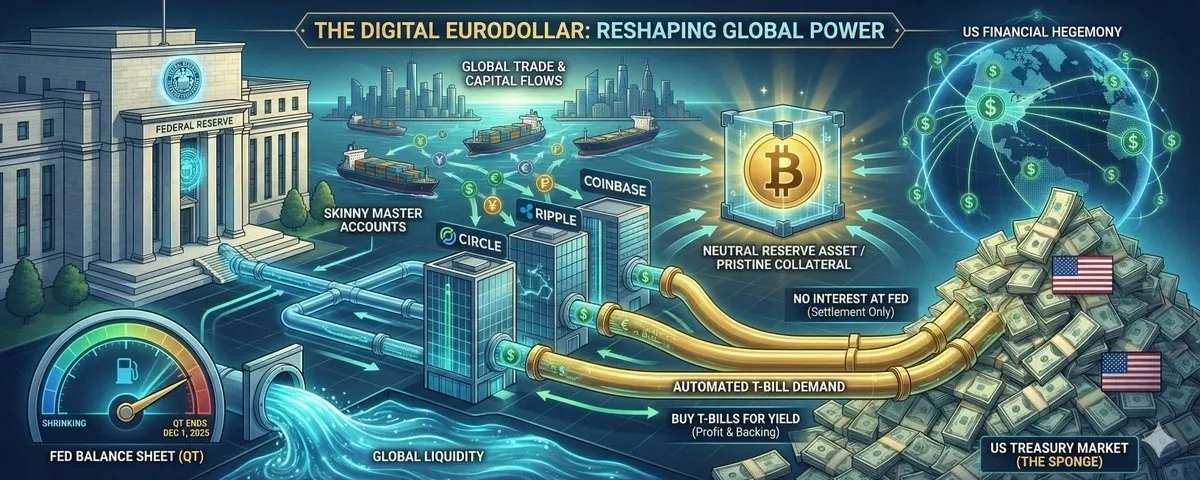
This technocratic adjustment – granting fintech firms like Circle, Ripple, and Coinbase direct access to Federal Reserve clearing rails – represents a quiet but radical privatization of the U.S. dollar’s global infrastructure. By inviting stablecoin issuers into the heart of the Federal Reserve System, Washington is not merely modernizing payments, it is constructing a “Eurodollar 2.0” network. This new architecture effectively co-opts the crypto revolution to extend American financial hegemony, turning potential challengers into the largest automated buyers of U.S. government debt.
The Treasury Sponge
To understand the magnitude of this shift, one must look at the plumbing. A “Skinny Master Account” allows a stablecoin issuer to hold cash directly at the Fed, bypassing the commercial banking system. Crucially, unlike traditional bank reserves, these accounts pay zero interest.
This creates a powerful, perverse incentive. To remain profitable, stablecoin issuers cannot simply park their customer funds at the Fed. Instead, they must use the Fed account merely for settlement while aggressively deploying the bulk of their reserves into short-term U.S. Treasury bills (T-Bills) to capture yields of 3-4 percent.
The timing is impeccable. As the Fed steps away from the bond market by ending QT, these newly empowered stablecoin issuers will step in. They are poised to become massive, price-insensitive buyers of U.S. debt. Every time a Brazilian importer or a Japanese pension fund utilizes a U.S. dollar stablecoin for trade settlement, capital flows directly into the U.S. Treasury market. The result is a “double pump” for liquidity: the removal of the Fed’s supply constraint combined with a structural demand shock from the crypto sector.
Dollar Hegemony 2.0
For decades, the primary vehicle for global dollar dominance was the Eurodollar system – offshore deposits held in foreign banks that greased the wheels of international trade. However, this system relied on a network of correspondent banks that was slow, expensive, and increasingly politicized.
The “Digital Eurodollar” offered by stablecoins solves these frictions. It offers instant settlement, 24/7 availability, and programmable compliance. By bringing issuers under the Fed’s regulatory umbrella through Skinny Master Accounts, the United States essentially deputizes these private firms. They become the new conduits for dollar dominance, penetrating markets where traditional banking relationships have frayed.
Consider the geopolitical irony, nations seeking to “de-dollarize” by trading in crypto assets may find themselves using stablecoins that are more tightly integrated with the U.S. Treasury than the old Swift network ever was. A “compliant” offshore dollar loop is created, where capital that was previously trapped in slow banking corridors becomes instantly mobile, yet ultimately tethered to U.S. sovereign debt.
The Neutral Reserve
In this reconfigured financial order, Bitcoin assumes a unique and critical role. As stablecoins become the de facto rails for global trade settlement, the system requires a form of neutral, pristine collateral – an asset that is not the liability of any single government or corporation.
Bitcoin is perfectly positioned to fill this void. As excess liquidity floods the system from the end of QT and the proliferation of stablecoins, capital will inevitably hunt for scarce, hard assets. Bitcoin’s correlation with “Net Liquidity” is well-documented. In a world of expanding digital dollar supplies, it serves as the ultimate hedge.
Moreover, if a peace treaty in Eastern Europe leads to the reintegration of Russian energy markets, Bitcoin may serve as the neutral settlement layer upon which these new stablecoin networks operate. It becomes the “digital gold” backing the “digital dollar,” creating a symbiotic relationship that reinforces, rather than threatens, the U.S. financial system.
Conclusion
The convergence of the GENIUS Act, the end of Quantitative Tightening, and the rollout of Fed Master Accounts marks a watershed moment in monetary statecraft. By integrating stablecoins into the sovereign stack, the U.S. outmaneuvered the narrative of crypto-anarchy.
The result will likely be a period of abundant global liquidity, structurally lower yields on U.S. debt, and a resurgence of American financial power – not through coercion, but through the sheer utility of its digitized currency. Far from being the undoing of the dollar, the crypto revolution may well be its salvation.
[1] Meyer-Brown, “Federal Reserve Governor Waller Introduces “Skinny” Master Account Concept and Signals Support for Payments Innovation”, 30 October 2025, https://www.mayerbrown.com/en/insights/publications/2025/10/federal-reserve-governor-waller-introduces-skinny-master-account-concept-and-signals-support-for-payments-innovation
JAS