Navigating America’s 21st Century Crossroads
America Requires a Comprehensive Strategy Rooted in an American System of Economics
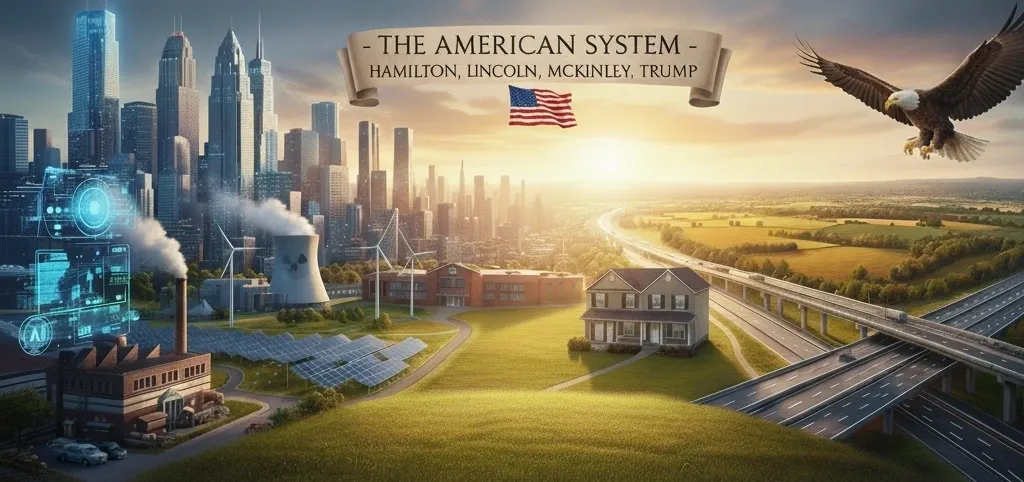
America is at a critical juncture. We face interconnected structural challenges that strain America’s economic and social foundations. Proponents of a nationalist approach argue these economic, technological, and cultural issues demand a comprehensive strategy rooted in the American System. A developmental framework championed by figures like Alexander Hamilton, Abraham Lincoln, William McKinley, and now by Donald Trump.
At the household level, the cost of living is spiraling out of control, placing immense pressure on families and is most acute in the housing and healthcare sectors. For housing, restrictive zoning laws and complex building regulations are seen as primary drivers that stifle the supply of new homes, pushing rents and mortgages beyond reach. The proposed fix involves aggressive deregulation to unlock a boom in home construction. Similarly, in healthcare, a lack of price transparency – where patients and employers cannot see the true cost of services – is blamed for hindering market competition. This requires is mandating clear, upfront pricing to empower consumers and force providers to compete.
America’s economic strain is seen as a direct consequence of neglecting the core pillars of the American System: a robust industrial base and world class national infrastructure. An American 21st-century economy requires the manufacturing capacity and infrastructure fit for a superpower. Such a revitalization requires securing cheap, reliable power through a massive expansion of energy production from new nuclear, coal, and gas plants. This effort reflects a modern interpretation of the “internal improvements” central to the Hamiltonian and Lincolnian vision of America’s industrial potential.
America’s national development extends to the technological challenge of winning the “AI War.” Beyond building power hungry data centers, this war requires retooling our outdated industrial-age education system for the AI Age, lest competitors like China take the lead. In keeping with an American system historically designed to protect domestic labor, this approach demands a “Human-First” implementation of AI automation. While companies will automate many jobs to stay competitive, this framework insists such a transformation must occur at a “human speed,” not at the “speed of profit.”
Combined, these economic and technological pressures exert a significant strain on America’s social fabric. This strain is further exacerbated by liberal and far-left progressives who see this time as an opportunity to implement their model of society to the detriment of traditional Judeo-Christian values and individual liberty. In response, America needs policies that are explicitly pro-human and pro-family, reinforcing what many see as the bedrock of the nation.
These challenges are interdependent. The cost of living is inseparable from energy policy, national security is tied to education reform, and societal stability rests on the well-being of the family. The solution is a comprehensive revitalization of the American System, updated to meet 21st-century challenges and aligned with President Trump’s “America First” agenda.
JAS