
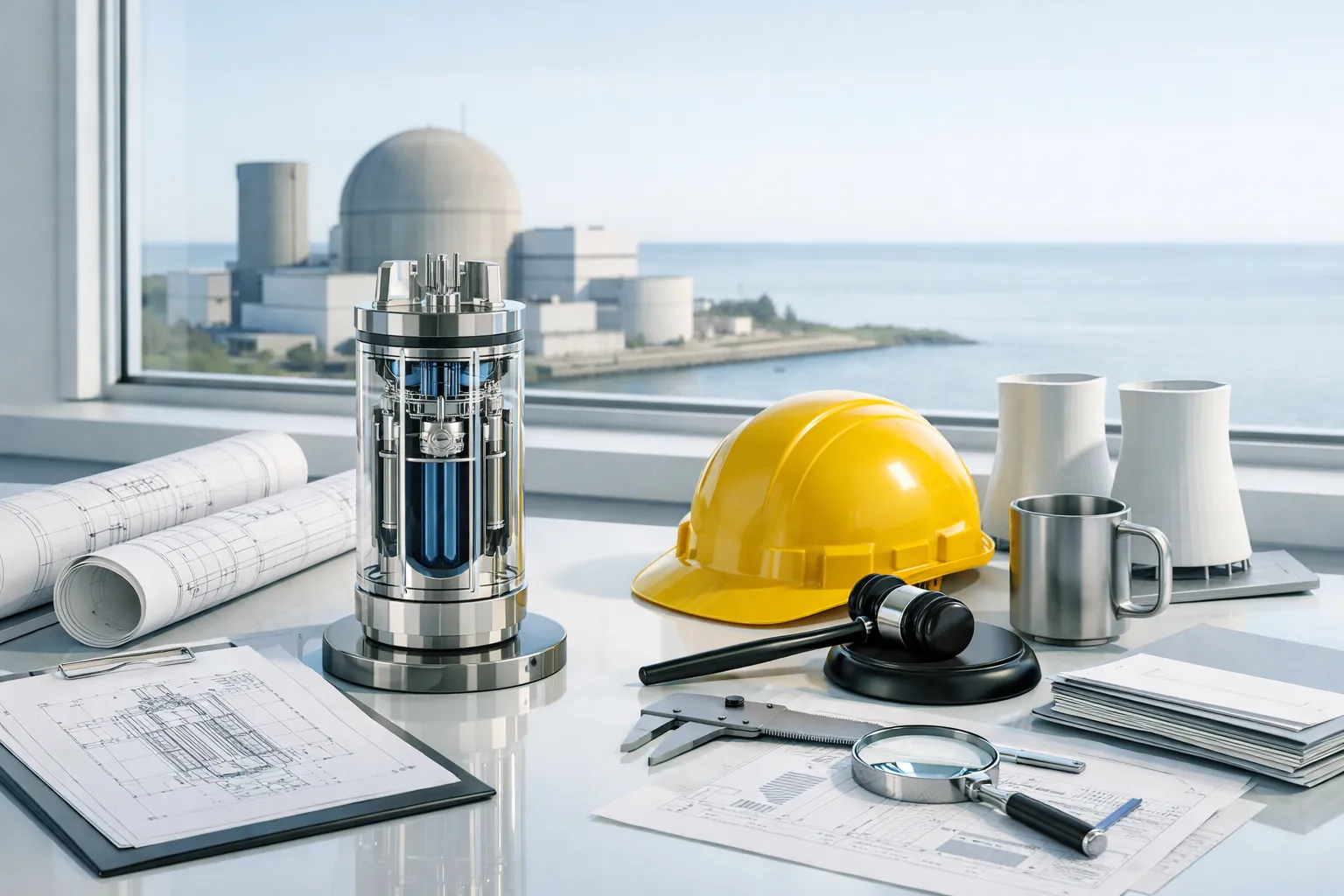
Delaware’s Renaissance Engine
Nuclear Abundance for the AI Age
As the AI revolution accelerates, the US faces a stark energy bottleneck. Hyperscale data centers, the computational backbone of tomorrow’s economy, are projected to drive electricity demand growth unmatched since the postwar industrial boom. The International Energy Agency estimates global data-center power consumption could double or triple by 2030, requiring a firm, carbon-free baseload that intermittent renewables alone cannot reliably supply.
States that secure abundant, low-cost energy will attract the capital-intensive industries of the future such as AI training facilities, advanced manufacturing, cryptocurrency mining, and biotechnology. Those that fail or deploy data centers without its own power source and closed loop water cooling system will watch investment migrate elsewhere.
Delaware, long the corporate domicile of choice for American business, now has an opportunity to extend that advantage into the digital era by becoming a hub for nuclear-powered computation.
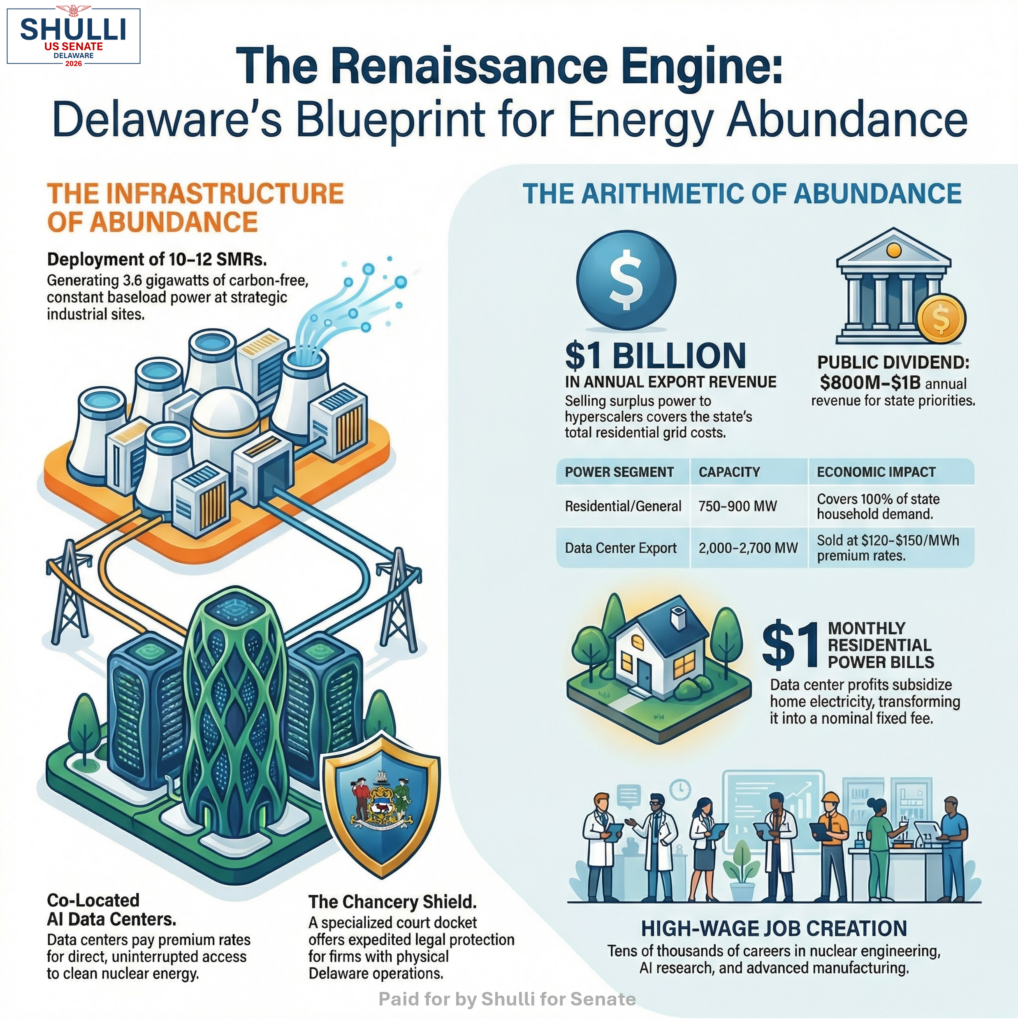
The core of this vision is what I call the Renaissance Engine: a replicable cluster integrating small modular reactors (SMRs), co-located data centers, university research hubs, advanced manufacturing companies, and tailored legal frameworks. By overbuilding nuclear capacity and exporting premium power to high-value users (data centers, advanced factories), Delaware can subsidize residential electricity to a nominal $1 per month while generating substantial public revenue and tens of thousands of high-wage jobs.
The Arithmetic of Abundance
Delaware’s roughly 474,000 households consume about 5.2 terawatt-hours of electricity annually, equivalent to a continuous demand of approximately 590–650 megawatts. Three modern SMRs, each rated at 300 megawatts, such as GE-Hitachi’s BWRX-300, could supply this entire residential load with surplus, operating at capacity factors above 93%.
Yet cheap generation alone does not translate to $1 monthly bills. Transmission, distribution, and grid maintenance currently account for half or more of the average Delaware residential bill of ~$155+. To reduce the consumer-facing price to a token fixed fee requires roughly $850 million annually in cross-subsidy.
The solution lies in scale. A full Renaissance Engine would deploy 10-12 SMRs, totaling 3-3.6 gigawatts of capacity. The base 750-900 megawatts serve residential and general loads while the remaining 2-2.7 gigawatts generate exportable power sold at premium rates ,$120-$150 per megawatt-hour, to data-center operators willing to pay for uninterrupted, clean baseload.
At a conservative $40-$60 per MWh margin above all-in production costs (estimated at $70-$80/MWh for mature SMRs), the export tranche could yield $800 million to $1 billion annually. This revenue stream would cover grid costs for households, fund infrastructure upgrades, and contribute to state priorities such as education and property-tax relief – without raising taxes.
A Proven Site and a National Model
The retired Indian River Power Plant in southern Delaware, already identified by the state’s Nuclear Energy Feasibility Task Force as a prime candidate, offers existing transmission infrastructure and cooling-water access. Additional industrial zones in New Castle County could host complementary clusters. Federal permitting reforms and targeted tax incentives, modeled on successful industrial policies elsewhere, would accelerate deployment.
The economic multiplier extends far beyond electricity. Co-location of data centers with nuclear plants creates a virtuous cycle: reliable power attracts hyperscalers, whose presence draws talent and ancillary industries. Additive manufacturing, AI-driven materials research, and blockchain infrastructure could follow, transforming Delaware from a corporate-law hub into a physical innovation center.
This is not speculative. Tech giants have already committed billions to SMR partnerships for data-center power. States that move first will capture the lion’s share of a market projected to require hundreds of gigawatts globally in the coming decade.
Policy Implications
Achieving this vision requires federal action: streamlined Nuclear Regulatory Commission licensing, liability protections under the Price-Anderson framework extended to advanced reactors, and temporary investment incentives conditioned on domestic deployment. Delaware’s congressional delegation,particularly its next senator, must champion these measures while defending the state’s corporate franchise against activist litigation that has recently driven incorporations elsewhere.
For too long, Delaware has benefited from financial innovation without corresponding investment in physical infrastructure. The Renaissance Engine offers a path to reclaim leadership by marrying the state’s legal sophistication with the energy abundance that the AI century demands.
A superpower cannot run on imported electrons and politicians who only know how to manage decline. By mastering the atom to power the algorithm, Delaware can ignite a new era of American prosperity – and show the nation how it is done, first.
FAQ
What is a Renaissance Engine? The Renaissance Engine is Colonel John Shulli’s integrated strategy to power a genuine American Renaissance—starting in Delaware and scalable nationwide—by combining abundant, sovereign energy with frontier compute, human excellence, and family strength.
Core Definition
The Renaissance Engine is a replicable cluster that pairs Small Modular Reactors (SMRs) for firm, carbon-free baseload power with co-located AI data centers, flexible loads (such as Bitcoin mining for grid balancing), university research hubs, and advanced manufacturing. By strategically overbuilding clean nuclear capacity and exporting premium power to high-value AI and industrial users, it generates substantial public revenue, subsidizes residential electricity to near-nominal cost, creates tens of thousands of high-wage jobs, attracts hyperscale investment, and funds the human foundations of long-term prosperity: classical education that develops AI-era leaders grounded in first principles, and Make America Healthy Again (MAHA) policies that strengthen families and reduce healthcare burdens.
It replaces managed decline with deliberate abundance—energy sovereignty, computational leadership, and a citizenry equipped to win the future.
How the Engine Works (Core Components)
- Energy Abundance (SMRs): Deploy 10–12 factory-built SMRs (e.g., ~3–3.6 GW total) at strategic sites such as the retired Indian River Power Plant. These provide always-on, carbon-free power that can be co-located with data centers to eliminate transmission losses and ensure 24/7 reliability.
- Computational Power (AI Data Centers + Flexible Loads): Hyperscale AI facilities and Bitcoin mining operations are sited directly with the reactors. Mining serves as a “revenue-generating battery,” absorbing surplus power and providing rapid demand response while monetizing energy that would otherwise be curtailed.
- Innovation & Talent Flywheel (University Research Hubs + Advanced Manufacturing): Co-located or networked university consortia democratize access to high-performance computing for materials science, drug discovery, fusion research, and more—creating spillover innovation and training the next generation of builders.
- Human Capital & Family Strength (Classical Education + MAHA): Revenue from power exports funds world-class classical education focused on the Western canon, logic, rhetoric, and deep understanding of physics and reality—producing “AI architects” who command machines rather than serve them. Parallel MAHA policies emphasize root-cause health, patient-centered care, lower costs through abundance, and strong families as the cornerstone of a thriving society.
- Smart Policy & Legal Frameworks: Specialized regulatory zones, expedited permitting, targeted tax incentives conditioned on local investment and physical presence, and dedicated judicial capacity accelerate deployment while protecting sovereignty and property rights.
Why It Matters
In the AI era, energy abundance and computational power are the twin foundations of national strength. The Renaissance Engine delivers both while ensuring the gains flow to Delaware families through cheap power, new jobs, education investment, and property-tax relief—without raising taxes. It transforms Delaware from a corporate-law hub into America’s premier physical infrastructure and innovation capital, proving that small states with bold leadership can outpace larger ones mired in red tape.
It is the opposite of managed decline: it is deliberate, physics-based, sovereignty-first building—the kind of engine that historically powered American ascendance and can do so again.