
The National Security Case for Nationalist Banking
To win the era of great-power competition, the United States must stop treating its strategic infrastructure as a financial casino.
For the past forty years, American economic statecraft has operated under a dangerous delusion: that financialization is synonymous with growth. While the United States optimized its economy for the velocity of capital – allowing private equity to leverage buyouts of hospital systems and hedge funds to securitize suburban neighborhoods – its geopolitical rivals focused on the velocity of production.
The result is a strategic vulnerability that no amount of defense spending can fix. A nation where housing is a speculative asset rather than shelter, and where healthcare is a yield-bearing instrument rather than a utility, is a nation with a brittle spine. In the event of a protracted global crisis, financial complexity becomes a liability, not an asset.
To restore American resilience, Washington must look beyond the minor regulatory tweaks of the post-2008 era. It requires a return to the structural wisdom of the American System, specifically a modernization of the 1933 Glass-Steagall Act. We need a “Strategic Asset Glass-Steagall” – a policy that does not merely separate commercial and investment banking, but legally bifurcates the economy into two distinct spheres: a protected Sovereign Utility System (Tier 1) and an unrestricted Dynamic Merchant System (Tier 2).
This is not a call for socialism, nor for the stifling bureaucracy of the current regulatory state. It is a Hamiltonian grand strategy to secure the rear guard of American society so that the vanguard can safely conquer the future.
The Cannibalization of the Homeland
The current crisis stems from a failure to distinguish between wealth creation and wealth extraction. Since the repeal of Glass-Steagall in 1999, the firewall between essential public utilities and high-risk speculation has evaporated.
Consider the hospital sector. Private equity firms now routinely execute leveraged buyouts (LBOs) of healthcare networks, loading them with debt to pay dividends to investors, then selling the hospital’s real estate to Real Estate Investment Trusts (REITs) for quick cash. The hospital, now a tenant in its own building, faces skyrocketing rent. When a crisis hits, these financially strip-mined institutions collapse. From a national security perspective, allowing financial intermediaries to weaken critical infrastructure is a dereliction of duty.
The same logic applies to commercial and residential housing. The entrance of institutional capital into the housing market has decoupled prices from local wages, turning the American middle class – the historic engine of political stability – into a permanent renter class. We have allowed the assets required for biological survival to be treated as identical to derivatives.
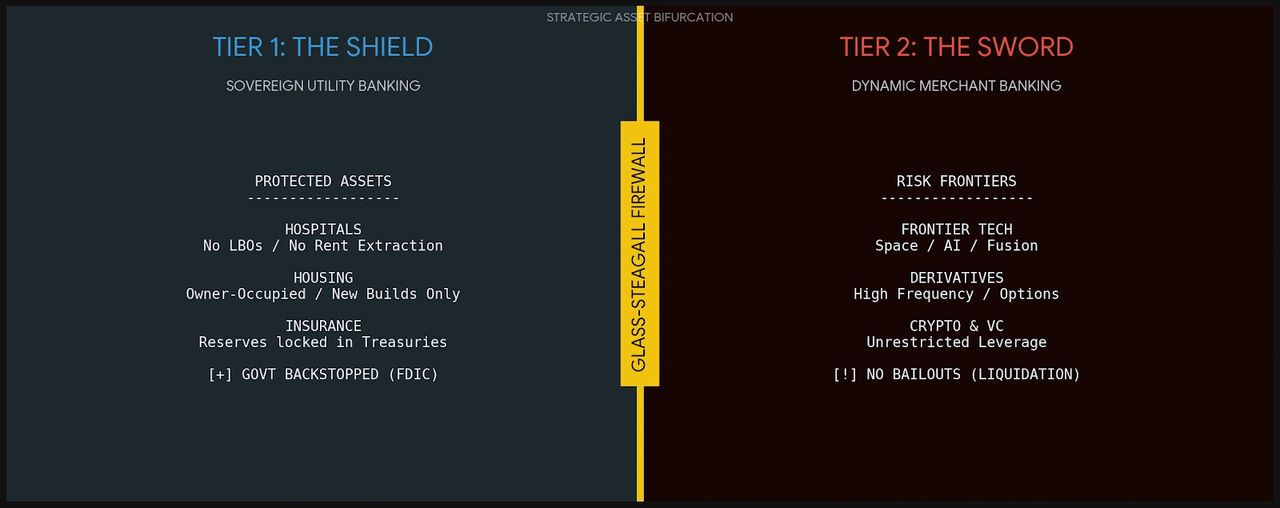
(Two Tiered Banking System for Enhanced Resilience in a Tokenized, AI-Driven Financial World.)
Tier 1: The Iron Dome for Strategic Assets
The proposed “Strategic Asset Glass-Steagall” begins by defining a Tier 1 Utility Banking System. This tier would enjoy 100 percent FDIC insurance and access to Federal Reserve discount windows, but in exchange, it would accept a strict “utility mandate.”
Under this mandate, Tier 1 banks would be legally prohibited from originating loans for speculative asset acquisition. Their function would be boring, stable, and essential.
The Healthcare Shield:
Hospitals and healthcare providers designated as “Critical Infrastructure” would be banned from LBOs. They could not pledge their assets as collateral for acquisition debt. Furthermore, sale-leaseback agreements with financial entities would be prohibited. Capital for physical expansion – new wings, MRI machines, research labs – would be provided by Tier 1 banks at low, fixed interest rates, prioritizing physical capacity over financial efficiency.
The Housing Firewall (Commercial & Residential):
The new framework would ban “Investment Tier” entities – hedge funds, PE firms, and REITs – from purchasing existing residential zoning titles. Tier 1 mortgages would be reserved exclusively for owner-occupied primary residences. For multi-family housing, Tier 1 credit is available strictly for new construction (increasing supply). Financing the mere acquisition of existing apartment blocks to raise rents would be exiled to the high-cost, uninsured Tier 2 sector. This effectively demonetizes the existing housing stock, crashing the speculative premium and realigning home prices with the physical economy.
The Insurance Lockbox:
Perhaps most critically, this reform would quarantine the insurance sector. The “float” – the massive reserves of premiums held by insurers – is currently a favored pool of capital for shadow banking. Under Tier 1 rules, policyholder reserves for health and auto insurance would be segregated from surplus capital and mandated for investment solely in U.S. Treasuries, municipal bonds, or Tier 1 infrastructure projects. Your car insurance premium should build a bridge, not leverage a derivative swap.
Tier 2: The Unleashed Frontier
Critics will argue that such protections stifle the “animal spirits” of the market. On the contrary, the current system stifles innovation by making rent-seeking easier than invention. Why invest in a risky fusion energy startup when you can squeeze guaranteed 8 percent yields out of a hospital chain?
By closing the door on parasitic rent-seeking, we can fling open the door to genuine risk. This is Tier 2: The Dynamic Merchant System.
In this tier, regulation vanishes. American citizens and institutions would be free to engage in maximum leverage, cryptocurrency speculation, exotic derivatives trading, and aggressive venture capital. The “Accredited Investor” rules – which paternalistically bar average citizens from high-upside investments – would be scrapped. Any American could open a “Merchant Account” to bet on the next big idea.
However, this freedom comes with a brutal Hamiltonian caveat: Zero Contagion. Tier 2 institutions would have absolutely no government backstop. No FDIC insurance. No bailouts. No “Too Big to Fail.” If a Tier 2 bank collapses, it is liquidated immediately.
Because the citizen’s home, health insurance, and checking account are safely housed in the Tier 1 Utility system, a crash in Tier 2 cannot threaten the social fabric. This liberates the U.S. government from the moral hazard of bailing out speculators to “save Main Street.”
The Geopolitical Dividend
For the United States to compete with state-led economies like China, it cannot simply copy their top-down control. It must leverage its unique strength: the ability to combine profound social stability with explosive entrepreneurial risk.
A “Strategic Asset Glass-Steagall” provides the synthesis. It stops the financial looting of the American interior, lowering the cost of living and revitalizing the industrial base. Simultaneously, it directs the nation’s appetite for risk away from predatory extraction and toward the technological frontier – AI, space flight, biotech, and advanced manufacturing.
The world is entering a period of scarcity and conflict where physical economics will trump financial statistics. A banking system that cannot distinguish between a casino chip and a hospital bed is a system destined to fail. It is time to rebuild the firewall.
JAS